
🚨 In a DIY emergency or rush?
Skip the details and jump straight to our 30-second cheat sheet for the most crucial info.
If your dishwasher door will not stay open, you are almost always dealing with a balance and hinge problem, not a washing problem. The door is meant to “float” at certain angles because the hinge springs (or spring and cable system) counterbalance the weight of the door. When that tension is wrong, the door either drops suddenly or springs back up.
Good news: this is usually a straightforward mechanical fix. Better news: you can diagnose most of it in 5 to 10 minutes with a flashlight and a little patience.
Publication note: Replace the image placeholders (the data-search tags) with real image assets before publishing.
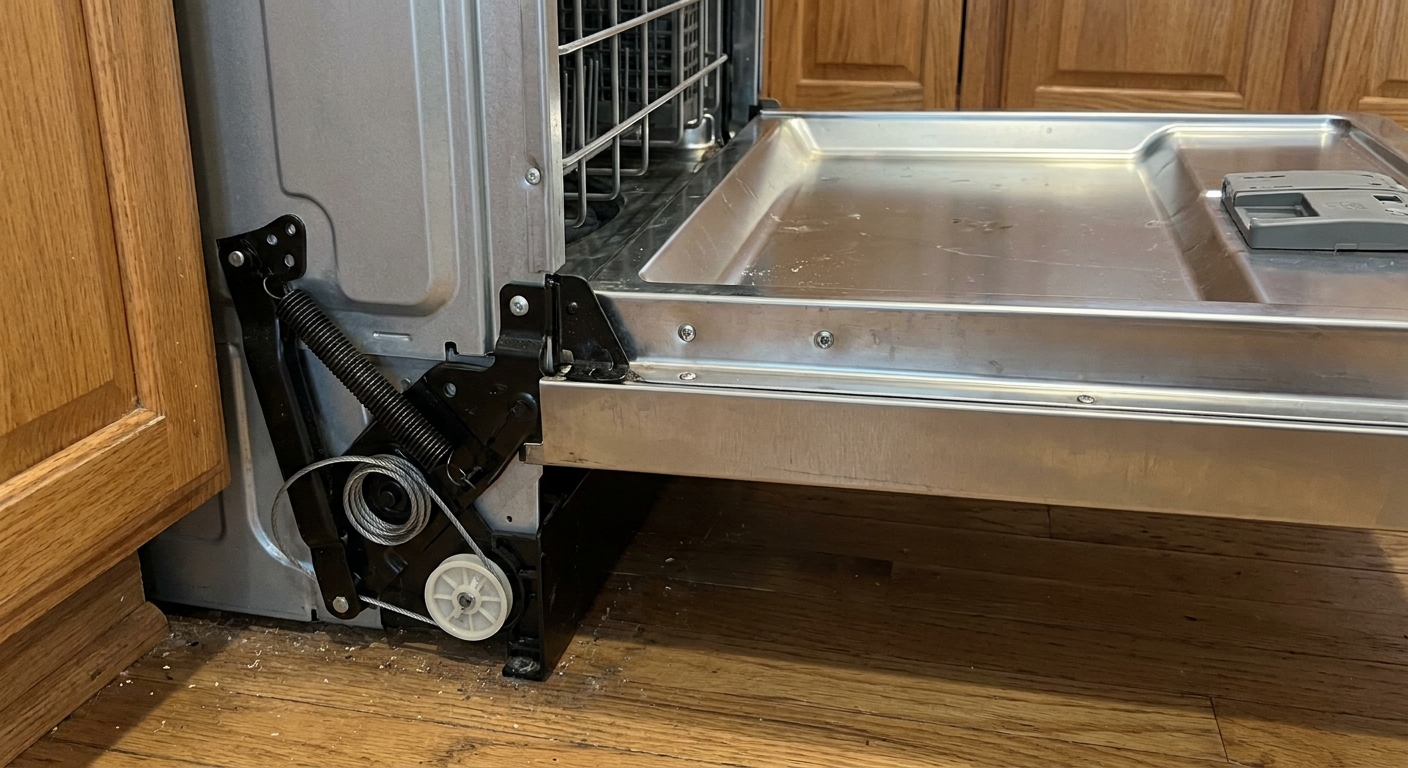
First check: not a latch issue
This article is for doors that won’t stay open or that fall shut while loading. That is usually a hinge and counterbalance issue.
Different symptoms point to a latch or alignment issue, which is a different repair:
- Door will not close unless you lift it or slam it.
- Door clicks open during a cycle or shows a “door” error.
- Door closes, but will not latch or pops back open.
If your door closes fine but won’t stay open, keep reading.
How the door should work
Most dishwashers use one of these setups:
- Spring and hinge arm: a metal spring hooks to the hinge arm directly.
- Spring plus rope or cable: a spring hooks to a cord or cable that routes around a pulley and connects to the hinge.
- Hinge link kit: some models use a plastic “door hinge link” instead of a traditional rope.
As the door opens, the springs stretch and provide counterbalance. If one side loses tension, the door gets twisty and wants to fall. If both sides lose tension, the door feels heavy and drops.
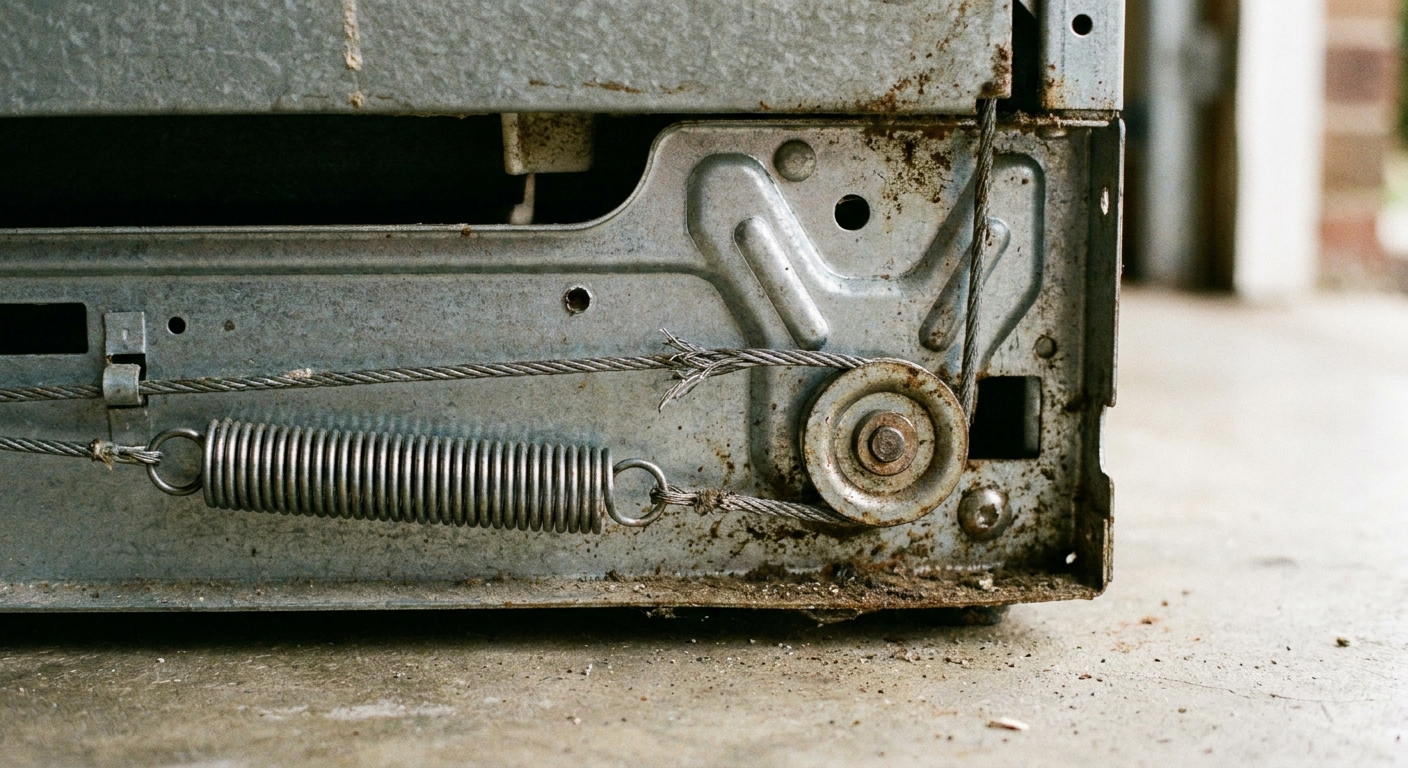
Safety and tools
Before you touch the hinges
- Turn off power at the breaker. You will be working near wiring and metal edges.
- Shut off the water if you plan to pull the unit out far.
- Wear gloves. Dishwasher frames are famous for sharp sheet metal.
- Support the door as you inspect. A bad spring or cable can let it drop suddenly.
Tools that help
- Flashlight or headlamp
- Phillips screwdriver or nut driver (varies by brand)
- Adjustable wrench (for leveling legs)
- Pliers (for spring hooks, used carefully)
- A towel or piece of cardboard (to protect flooring if sliding the dishwasher)
Quick diagnosis
Door drops fast and feels heavy
- Broken spring
- Spring came unhooked
- Rope, cable, or hinge link snapped
- Cable slipped off pulley
- Pulley missing, cracked, or jammed
Door twists or drops more on one side
- Only one spring, cable, or hinge link failed
- One side routed wrong after a previous repair
- Hinge arm bent (less common, but it happens)
Door will not stay open unless you push it all the way down
- Weak springs (fatigue over time)
- Wrong replacement springs (too light duty)
- Added door weight (panel-ready wood panel)
- Friction at hinge pivot (binding makes balance inconsistent)
Door springs back upward or will not stay down
- Too much spring tension
- Spring attached to the wrong hole or bracket
- Cable routed incorrectly (shortened effective length)
- Wrong spring kit for your door weight
Whole dishwasher tips forward when the door opens
- Unit is not securely screwed into the cabinet using the mounting brackets.
- Mounting tabs are bent, missing screws, or the top side brackets were never installed.
Check mounting first
I have seen plenty of “bad spring” reports that were really a loose installation. If the dishwasher is not secured to the surrounding cabinets, opening the door can make the whole unit tip forward. That changes the door angle and can feel like a balance failure.
What to do
- With the door mostly closed, grab the top of the dishwasher frame and gently test for movement.
- Look for mounting brackets at the top (under the counter) or on the sides (into the cabinet walls), depending on your model and countertop type.
- Tighten or replace missing mounting screws. If the tabs are damaged, replace the bracket kit.
Installation and interference
A bubble level being slightly off usually is not enough by itself to make a door slam. The bigger issue is typically a racked frame, countertop interference, or mounting screws that torque the dishwasher into a twist.
1) Check for rubbing
- Open the door slowly and look for the top edge rubbing the underside of the counter.
- Check that side gaps are even and the unit is centered.
- Make sure the mounting tabs are not bent in a way that torques the frame.
2) Confirm level and rack
Use a small level on the tub lip or inner door. Also look at the door as it opens. If it looks like it is being pulled sideways, suspect a twist.
- Front too high: door can feel like it wants to close.
- Side-to-side off: door may twist and fall more on one side.
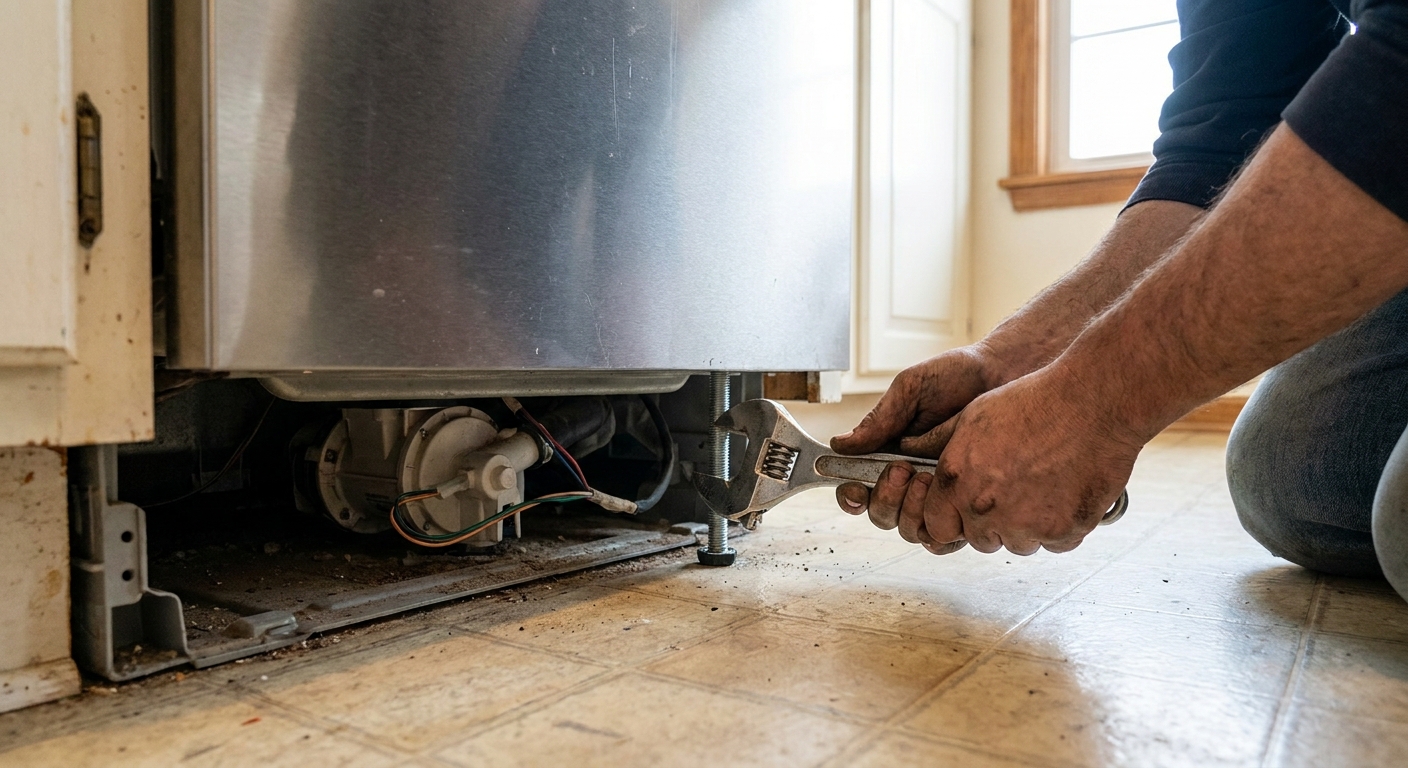
3) Adjust legs
Most models have front leveling legs. Many also have a rear adjuster accessed from the front kick plate area.
My rule: adjust in small turns, recheck, and test the door each time. One extra half turn can change door behavior more than you would expect.
Panel-ready doors: extra weight matters
If you have a panel-ready dishwasher and recently added a custom wood cabinet panel, that extra weight can overwhelm standard springs. The door may suddenly feel heavy and fall shut even though nothing is technically broken.
What to do
- Confirm the panel matches your model’s allowed weight range (check your installation manual).
- Look for a manufacturer-approved heavy-duty spring kit or door balance kit designed for panel-ready installations.
- Do not guess on spring strength by looks. Match parts by model number.
Inspect springs, links, and pulleys
If mounting and interference are fine, it is time to look at the counterbalance hardware. This is where most “door won’t stay open” problems live.
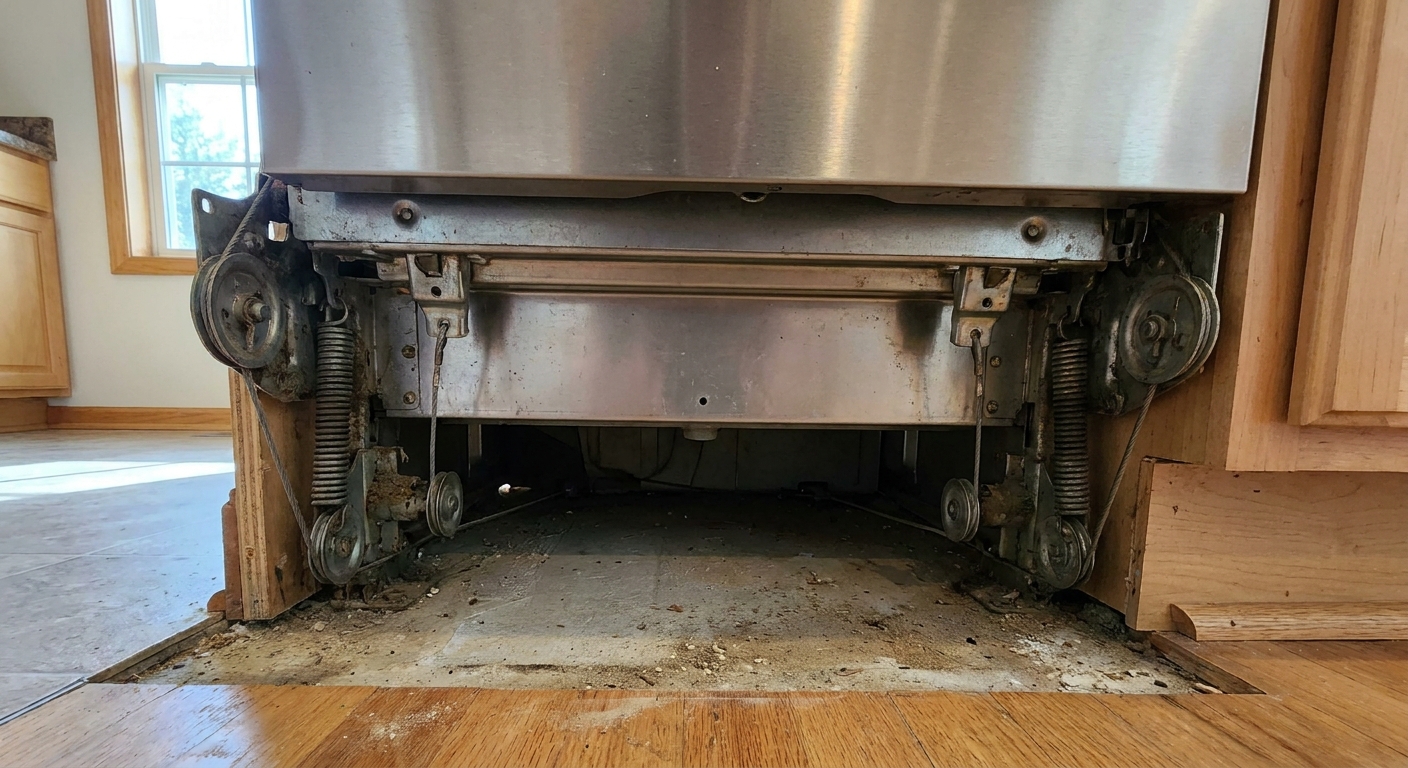
1) Remove the toe kick
At the bottom front of the dishwasher, remove the screws holding the toe kick and insulation panel. Keep the screws together. Some models use two panels.
2) Inspect both sides
You are looking for symmetry. The left and right side should look like mirror images.
- Spring: intact, not snapped, not stretched into a weird shape.
- Rope, cable, or hinge link: not frayed, not cracked, not broken, routed correctly.
- Pulley: present, not cracked, spins freely, cable sits in the groove.
- Attachment points: hooks seated fully in holes or slots.
If one side is broken, replace parts in pairs when possible. A new spring on one side and an old spring on the other can still leave you with a twisty, annoying door.
Fix 1: Rehook a spring
If the spring is intact but unhooked, you may be able to reattach it.
Steps
- Kill power at the breaker.
- Close the door to reduce spring tension while you position the hook.
- Use pliers to guide the spring end into the correct hole or bracket. Keep your fingers out of the pinch zone.
- Open the door slowly and test. Watch that the spring stays seated.
Heads up: if a spring popped off once, it can mean the retaining hole is worn, the link is stretched, or the routing is wrong. If it pops off again, replace the worn hardware instead of playing whack-a-mole.
Fix 2: Replace a rope, cable, or link
Many dishwashers use a rope, sometimes called a door balance link. Others use a braided cable. Some use a plastic hinge link kit. When it snaps, the door immediately feels heavier and drops.
What to look for
- A dangling rope end near the spring
- Frayed strands
- A cracked plastic link
- A cable that jumped off the pulley and got chewed up
Replacement tips
- Take a photo of the routing before removing anything on the good side. That “good” side is your reference.
- Replace both sides if they are the same age. If one failed, the other is usually not far behind.
- Make sure the cable sits fully in the pulley groove.
After replacement, open and close the door slowly a few times while watching the pulley. It should roll smoothly, not hop or bind.
Fix 3: Replace weak or incorrect springs
Springs fatigue. They also get replaced incorrectly more often than you would think. If your door used to stay open but now slowly creeps closed, weak springs are high on the list.
How to confirm
- No broken parts visible
- Door drops, but not violently
- Both sides look intact and evenly routed
Buy the right spring
Use the dishwasher model number from the tag and match the exact part number when possible. The tag is usually on the tub frame around the door opening, often along the left or right side, and sometimes on the side of the door itself.
Budget note: aftermarket spring kits can work fine, but if the tension rating is off, you will be back where you started. If reviews mention “door still falls” or “door won’t stay down,” skip that listing.
Fix 4: Adjust spring tension
Some designs have multiple holes or slots where the spring or cable can be attached. Moving the connection point changes leverage and tension.
General adjustment logic
- Door falls shut: you need more counterbalance tension.
- Door springs back upward or won’t stay down: you need less tension.
Make adjustments evenly on both sides. If you change only one side, the door can start twisting and wearing hinges faster.
My habit: I mark the current hole with a bit of tape before moving anything. It saves you from the “wait, where was it originally?” moment.
Fix 5: Binding at the hinge
Sometimes the tension system is fine, but the hinge does not move smoothly. Binding can make the door feel unpredictable, like it sticks and then suddenly drops.
Common causes
- Gunk buildup at the hinge area
- A slightly bent hinge arm
- Cabinet installation squeezing the dishwasher frame
- Loose mounting screws causing the unit to rack
What to do
- With power off, open and close the door slowly while watching the hinge arms. They should move evenly.
- Check for rubbing marks on the frame.
- Tighten mounting screws and confirm the unit is not twisted.
- Clean visible grime. Avoid spraying lubricant blindly into the hinge area. Some manufacturers specifically say do not lubricate hinge and spring components. If lubrication is recommended by your manufacturer, use the specified product and apply sparingly.
When to replace hinge hardware
If you see a hinge arm that is bent, cracked, or has an elongated pivot hole, replacement is usually the right move. Springs and cables cannot compensate for a hinge that is changing geometry every time the door moves.
Replace the hinge kit if you notice
- Door is visibly crooked when partially open
- A clunking or popping sound at the hinge
- Metal fatigue or cracks
- Door works for a day, then starts falling again because the hinge is deforming
On many models, you can buy a left and right hinge kit. If you are already in there, doing both sides at once is usually cheaper than repeating the job later.
Workflow to follow
If you want the “do this in order” approach, here is my go-to sequence:
- Confirm symptoms: door falls shut or won’t stay open, not a latch issue.
- Check mounting: verify the unit is secured and not tipping forward.
- Interference and rack: verify the frame is not twisted and the door is not rubbing the counter.
- Toe kick off: inspect both sides for symmetry.
- Find the failure: broken spring, snapped rope, broken link, pulley problem, or bad routing.
- Fix the failure: rehook or replace parts in pairs.
- Test slowly: open to halfway and fully open several times.
- Final check: reinstall toe kick, run a quick rinse cycle and confirm normal operation.
Cost and time
- Rehooking a spring: 10 to 20 minutes, $0
- Replacing rope, cable, or link set: 20 to 45 minutes, usually $10 to $35
- Replacing springs: 20 to 45 minutes, usually $15 to $50
- Replacing hinge arms: 45 to 90 minutes, often $30 to $120 depending on model
- Panel-ready heavy-duty spring kit: varies by brand, often similar to spring pricing but can be higher for OEM kits
These are broad, typical DIY parts-only estimates. Prices vary widely by brand and whether you buy OEM.
When to call a pro
I am all for DIY, but call for backup if:
- You see damaged wiring, water leaks at the base, or signs of burning.
- The dishwasher must be pulled out and the supply line or drain setup is brittle or corroded.
- The frame is badly twisted or the unit was installed incorrectly and needs re-mounting.
And if the door is slamming shut hard enough to feel unsafe, treat it like a pinch hazard. Support it while you troubleshoot.
FAQ
Why did my dishwasher door suddenly start falling shut?
Most commonly, one spring broke or a rope, cable, link, or pulley failed on one side. The “sudden” part is usually because it finally gave up after slowly fraying or fatiguing. Another common “sudden” cause is adding a panel-ready wood door without upgrading the spring kit.
Should I replace both springs or cables if only one failed?
Yes, if you can. Matching tension side-to-side keeps the door balanced and reduces hinge wear.
Can being out of level cause this?
It can contribute, but more often it is a twisted, racked installation or countertop interference. Still, it is a quick check and worth doing before ordering parts.
My door will not stay open and also will not latch. Which do I fix first?
Fix the hinge balance first. A door that droops can misalign the latch strike and make a latch seem “bad” when it is really just not lining up.
The 30-Second Cheat Sheet
Essential takeaways for: Dishwasher Door Won’t Stay Open? Fix Hinges and Springs
Fast diagnosis
- Door drops suddenly: broken spring, snapped rope or cable, hinge link failure, cable off pulley, or pulley jam.
- Drops more on one side: one-side spring or cable failure, hinge link failure on one side, or incorrect routing on one side.
- Slowly creeps closed: weak springs, added door weight (panel-ready wood panel), or the dishwasher frame slightly racked from installation.
- Door wants to lift up: too much tension, spring attached to the wrong hole, wrong spring kit, or cable routed incorrectly.
- Whole unit tips forward when door opens: dishwasher not secured to cabinets with mounting brackets or screws.
What to check first (in order)
- Not a latch issue: this guide is for doors that will not stay open, not doors that will not close or latch.
- Mounting and frame: confirm the unit is screwed in and not tipping forward.
- Interference and rack: confirm the unit is not rubbing the countertop and the frame is not twisted.
- Toe kick off: inspect both sides for symmetry.
- Springs and links: look for a snapped spring, frayed rope, broken cable, broken plastic hinge link, or pulley problems.
Most common fixes
- Rehook an intact spring that popped off (power off, door mostly closed to reduce tension).
- Replace rope, cable, or hinge link if snapped, frayed, or cracked. Make sure it sits fully in the pulley groove.
- Replace springs if weak, mismatched, or after adding a panel-ready wood door. Replace both sides when possible.
- Adjust tension only if your model has multiple attachment holes. Keep both sides matched.
Safety reminders
- Turn off power at the breaker before working near hinges.
- Support the door so it cannot drop on fingers.
- Watch for sharp sheet metal edges behind the toe kick.
When to stop DIY
- Hinge arm is bent or cracked, or the frame is twisted and needs reinstalling.
- You see leaking at the base, damaged wiring, or burning smells.
💡 Tip: Scroll up to read the full article for detailed, step-by-step instructions.
⬆️ Back to top
About Marcus Vance
Content Creator @ Grit & Home
Marcus Vance is a lifelong DIY enthusiast and self-taught home renovator who has spent the last decade transforming a dilapidated 1970s ranch into his family's dream home. He specializes in budget-friendly carpentry, room-by-room renovations, and demystifying power tools for beginners. Through his writing, Marcus shares practical tutorials and hard-learned lessons to help homeowners tackle their own projects with confidence.