
🚨 In a DIY emergency or rush?
Skip the details and jump straight to our 30-second cheat sheet for the most crucial info.
If your grinder pump alarm is going off, your goal is simple: stop the tank from overflowing and protect your home from sewage backing up. The alarm is not there to annoy you. It is there because the pump basin is getting too full or the system is not pumping out like it should.
One safety rule up front: if you see sewage backing up anywhere, stop using water and call for service. This is not a “push through it” situation.
I have learned this the hard way on DIY projects: the biggest damage usually happens in the first hour, when people keep running water “just to finish up.” So let’s slow down, get organized, and handle the basics in the right order.
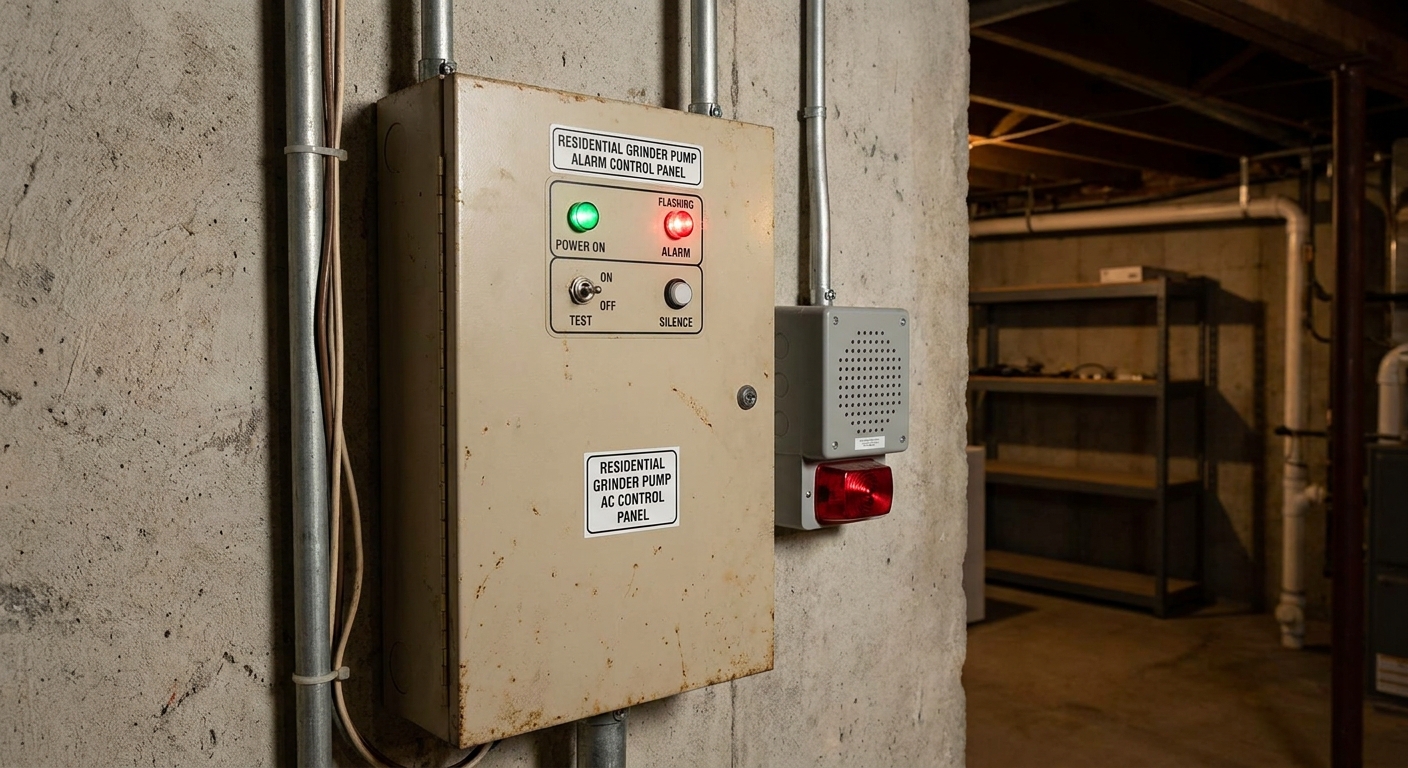
Grinder pump vs. ejector pump
Homeowners often search “sewage pump alarm” and end up reading about sewage ejector pumps or even sump pumps. Those are cousins, not twins.
Grinder pump
- Purpose: Grinds wastewater solids and pumps it through a small-diameter pressure line to a municipal main or to part of a septic setup.
- Where it lives: Usually in a buried basin outside, or sometimes in a basement pit depending on the property.
- Big risk: If it cannot pump out, the basin level rises and can back up into the house.
Sewage ejector pump
- Purpose: Lifts sewage up to gravity sewer when fixtures are below the main line.
- Usually: No grinder. It relies on impeller pass-through size, so it can handle typical sewage and toilet paper, but it is still vulnerable to wipes, hygiene products, and “stringy” debris.
Why this matters: any pump system can be affected by power interruptions and float problems. Grinder pump systems are often tied to pressure sewer setups with smaller force mains, which can be more sensitive to freezing, restrictions, and certain clogs. The response steps below are safe for most systems, but grinder pumps tend to reach the “call for service” point sooner when a force main is blocked or frozen.
What the alarm means
Most grinder pump alarms are a high-water alarm. Wastewater has risen above the normal “pump on” level and has reached the higher alarm float.
- Power outage or tripped breaker: Pump cannot run, level rises.
- Pump failure: Motor, impeller, grinder mechanism, or capacitor issue.
- Discharge line problem: Freeze, blockage, closed valve, or a check valve issue that lets wastewater flow back and prevents net progress.
- Float problem: Float stuck, tangled, or failed.
- Control panel issue: Relay, fuse, or alarm circuit problem.
Important: some panels also alarm for other faults (for example over-temp, seal leak, or general fault) depending on the pump and controls. If your panel has a label or legend, follow that first. If you are not sure what the alarm is indicating, treat it like high water until a pro confirms otherwise.
Sometimes the alarm is “false” (failed alarm float), but you should assume it is real until you prove otherwise.
What to do first
Step 1: Stop using water
This is the fastest way to prevent an overflow. Treat your plumbing like it is “on pause.”
- Do not flush toilets unless it is an emergency.
- Do not run showers, baths, dishwashers, or washing machines.
- Avoid sinks, garbage disposals, and long handwashing sessions.
Quick reality check: a shower can easily add 15 to 25+ gallons depending on flow rate and how long it runs. If the pump is not moving water out, that volume has nowhere good to go.
Step 2: Silence the alarm
Most panels have an Alarm Silence or Mute button. Pressing it should stop the noise while the light stays on.
- Do not open the control panel unless your manual explicitly says it is homeowner-serviceable and you have turned off power at the breaker. Some panels have live voltage inside, and opening them can create safety and warranty issues.
- Silencing the buzzer does not fix anything. It just buys you sanity while you troubleshoot.
Step 3: Look for emergency signs
Call for professional help immediately if you see any of the following:
- Sewage backing up into a shower, tub, floor drain, or toilet.
- Wet ground around the grinder pump basin or a strong sewage odor outside where the basin is located.
- Alarm with no recent outage or breaker trip you can explain, and the level is still rising.
When sewage is involved, this is not a “learn as you go” moment. It is a health hazard and cleanup is expensive.
Safe homeowner checks
These checks are meant to answer one question: Is the pump unable to run, or is it running but not pumping?
Check 1: Panel lights and labels
Every panel is a little different, but many have some combination of:
- Power light
- Pump Run light
- High Water or Alarm light
- Sometimes a labeled fault light (for example Overtemp, Seal Leak, or Fault)
If the Power light is off, you likely have an electrical issue upstream.
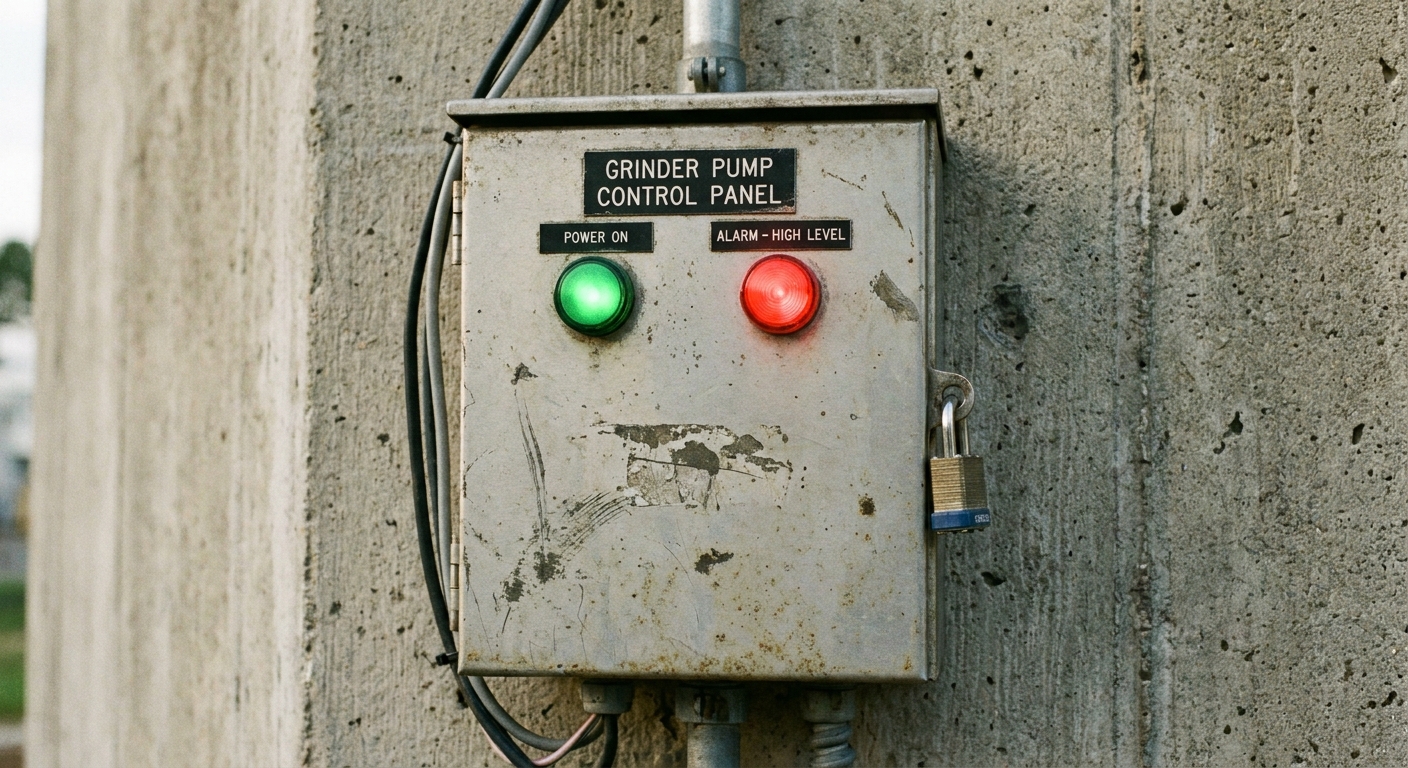
Check 2: Breaker and GFCI
Grinder pumps are often on a dedicated breaker. If it is tripped, reset it once.
- If it trips again quickly, stop resetting. That points to an electrical fault or a failing motor. Call service.
- Also check for a tripped GFCI receptacle if your setup uses one.
Safety note: If the area is wet, do not touch electrical equipment. Keep hands dry and stand on a dry surface.
Check 3: Listen for pump activity
If you can safely get near the basin or the control area:
- Do you hear the pump running or humming?
- Does it cycle on and off?
What it suggests:
- Silent, no run: power issue, float issue, control issue, or failed motor.
- Humming but not pumping: jam, seized pump, bad capacitor, or mechanical failure.
- Running constantly: float stuck “on,” significant inflow, discharge restriction, or backflow from a failing check valve.
Check 4: Discharge valve position
Some installations have a ball valve on the discharge line near the basin or inside a valve box. If someone closed it during work, the pump may be pushing against a closed valve.
- If you see a valve handle and you are sure what it is, confirm it is in the fully open position.
- If you are not sure what you are looking at, stop and call a pro. Do not start turning random valves on a sewage system.
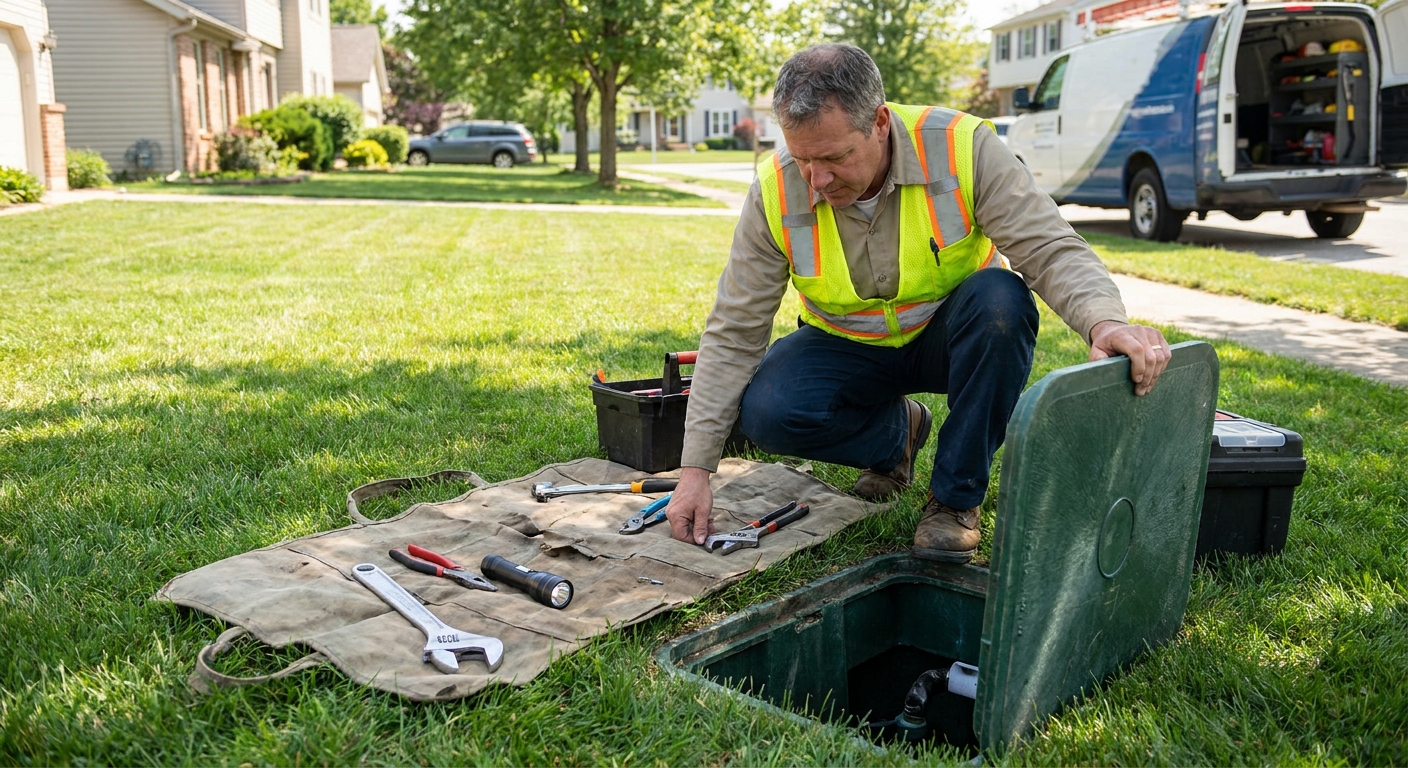
Check 5: Basin access and floats (only if safe)
This varies a lot by system and location. If your basin is outside and accessible, you may be able to see float cords through an access port or after removing a cover.
- Never enter the basin and do not put your head or torso over an open pit. This can become a confined-space hazard fast.
- Do not put hands in wastewater.
- If you can clearly see a float hung up on the side, gently freeing the cord can sometimes get you back in business.
If the basin is indoors, or you have any doubt about exposure, skip this and call service.
Water use while the alarm is on
If the alarm is active, assume the basin is near capacity. The safest move is no water use until the pump catches up or service arrives.
If you absolutely must use water, keep it to the bare minimum:
- Short handwashing only.
- No toilet flushing unless necessary, and understand it may be the flush that pushes the system over the edge.
- No laundry, no dishwasher, no long showers.
Tip from my own mistakes: If you have guests or kids in the house, physically block off bathrooms or tape a note to faucets. It sounds silly until you are mopping up what should have stayed in the pipes.
What not to do
- Do not keep resetting a tripping breaker. One reset is the limit.
- Do not bypass floats or try to “force run” a pump unless your manual and a technician specifically instruct you.
- Do not open the control panel to mess with wiring or buzzers.
- Do not try to snake or jet a pressure sewer force main yourself. Call a pro with the right equipment.
- Do not enter the basin or treat it like a normal open pit.
Common causes
Power and controls
- Storm outage
- Tripped breaker
- Failed control panel component
If your neighborhood just flickered and the alarm came on, this may resolve once power is stable, but you still need to confirm the pump actually ran and lowered the level.
Discharge line and check valve issues
- Frozen line in cold climates
- Blocked or restricted line
- Valve closed accidentally
- Failing check valve causing backflow and short cycling
If the pump runs but the level does not drop, suspect a restriction, severe backflow, or pump failure.
What not to flush or drain
Grinder pump manufacturers are pretty consistent here. The fastest way to shorten pump life is feeding it things it was never meant to chew.
- Wipes (even “flushable”)
- Feminine hygiene products
- Paper towels
- Grease, fats, or food scraps
- Dental floss, cotton swabs, hair
- Kitty litter
When to call for service
My rule: if the alarm is on and you cannot confidently identify a simple cause within a few minutes, it is time to call.
- Sewage is backing up anywhere in the house.
- Breaker trips repeatedly after a reset.
- Pump runs but level does not drop (possible restriction, frozen line, severe backflow, or failed pump).
- Alarm persists more than 15 to 30 minutes with water use stopped.
- You see wastewater around the basin, in a yard, or in a pit.
Also consider this: in some pressure sewer neighborhoods, an issue with the community system can affect multiple homes. If neighbors are also alarming, call your utility or the entity that maintains the pressure main, and still limit water use in your home.
Tell the technician: you have a grinder pump system, the alarm type shown on the panel, what the panel lights show, whether the pump is running, and whether you had a power outage or freezing temperatures.
After it clears
Once things return to normal, take 2 minutes to confirm you are actually out of the woods:
- The alarm light resets (or turns off) after the level drops.
- You hear a normal pump cycle and it shuts off instead of running nonstop.
- The alarm does not come back quickly when you resume normal water use.
If the alarm returns the same day, go back to “stop water use” and call service. That usually means the underlying issue is still there.
Quick questions
Can I just turn the grinder pump off?
If it is alarming due to high water, turning it off can make things worse because you remove the chance it will catch up. The better move is to stop water use and troubleshoot power safely. If the pump is shorting out or tripping the breaker, leave it off and call service.
Will the alarm clear on its own?
Sometimes, yes. If the cause is a brief power interruption and the pump resumes normal operation, the level drops and the alarm float resets. But you should still verify the system is working by checking the panel and listening for a normal cycle.
Is this the same as a septic alarm?
Not always. Some septic systems use pumps, some do not. A grinder pump typically indicates a pressure sewer or specialized setup. If you are unsure, look for a control panel labeled with the pump brand or “grinder,” or check your home inspection paperwork.
Preventing the next alarm
- Know your panel: Take a clear photo of the lights and labels when things are working normally.
- Keep a “do not flush” list: Especially if you host guests or have kids.
- Ask about maintenance: Some systems benefit from periodic inspection of floats, check valves, and controls.
- Plan for outages: If your area loses power often, ask a pro whether a generator or battery backup is appropriate for your specific setup.
If you only remember one thing: when the alarm goes off, your water use is the throttle. Reduce inflow first, then diagnose.
The 30-Second Cheat Sheet
Essential takeaways for: Grinder Pump Alarm Going Off? What to Do First
Do this first
- Stop using water immediately. No toilets, showers, laundry, or dishwasher until you know the pump is lowering the level.
- Press “Alarm Silence” to mute the buzzer (light usually stays on).
- Look for sewage backup in tubs, showers, floor drains, or toilets. If you see backup, call emergency service now.
Fast checks (safe for most homeowners)
- Check the control panel: note which lights are on (Power, Pump Run, Alarm/High Water, and any other labeled fault).
- Check the breaker or GFCI: reset a tripped breaker one time only. If it trips again, stop and call a pro.
- Listen for the pump: running, humming, or dead silent helps a tech diagnose quickly.
- If accessible, confirm the discharge valve is open (only if you are sure it is the pump discharge valve).
When to call a pro right away
- Sewage is backing up in the house.
- The alarm stays on 15 to 30 minutes after you stopped water use.
- Breaker trips repeatedly or there is burning smell.
- Pump runs but the level does not drop (possible frozen line, blockage, severe backflow, or pump failure).
What to tell the technician
- You have a grinder pump (not just a sump pump).
- What the panel lights show (and any labels like High Water, Overtemp, Seal Leak, or Fault).
- Whether the pump is running, humming, or silent.
- Any recent power outage, storm, or freezing temperatures.
- Whether neighbors are having similar issues (possible utility or pressure main problem).
💡 Tip: Scroll up to read the full article for detailed, step-by-step instructions.
⬆️ Back to top
About Marcus Vance
Content Creator @ Grit & Home
Marcus Vance is a lifelong DIY enthusiast and self-taught home renovator who has spent the last decade transforming a dilapidated 1970s ranch into his family's dream home. He specializes in budget-friendly carpentry, room-by-room renovations, and demystifying power tools for beginners. Through his writing, Marcus shares practical tutorials and hard-learned lessons to help homeowners tackle their own projects with confidence.