
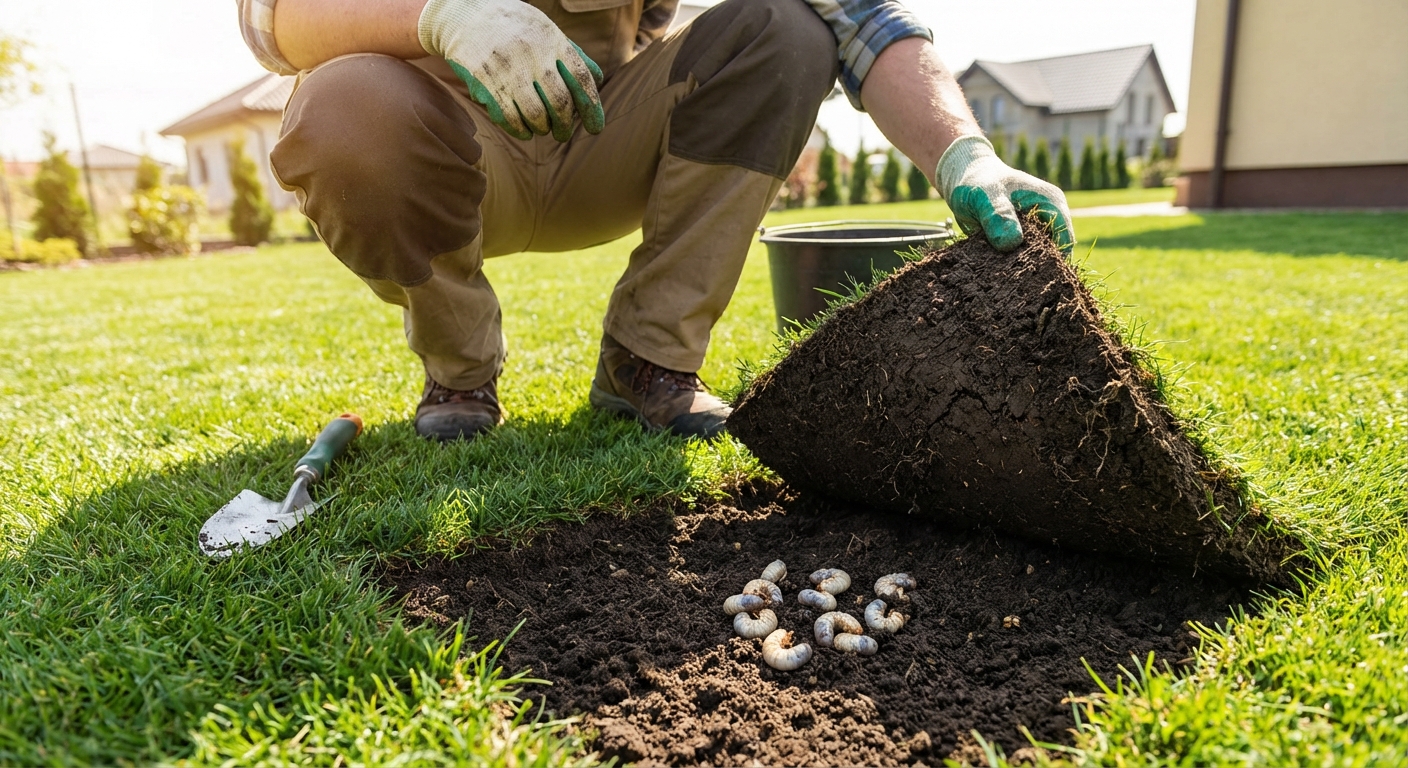
If you have random brown patches that peel up like old carpet, there is a good chance you are dealing with lawn grubs. I learned this the hard way after blaming my sprinklers for a month, only to roll back a dead patch and find a whole party of little C-shaped freeloaders chewing on roots.
The good news is you can beat grubs without turning your yard into a chemistry experiment. The trick is choosing the right approach for the right time of year: curative treatments when grubs are actively feeding near the surface, and preventive treatments before eggs hatch or right as they start hatching.
What are lawn grubs?
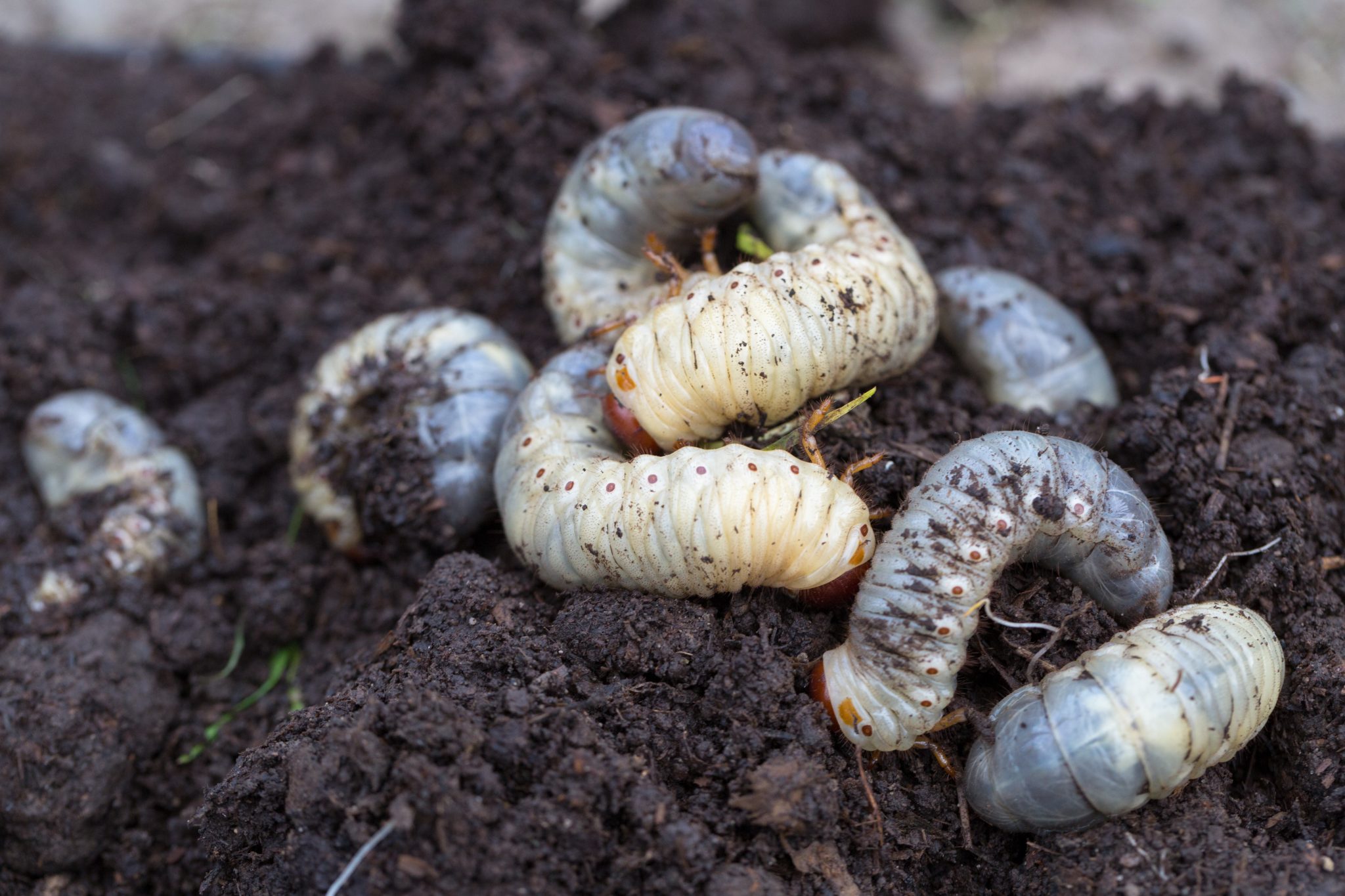
“Grubs” are the larval stage of several beetles. Depending on where you live, the most common culprits are:
- Japanese beetle
- June beetle (June bug)
- European chafer
- Masked chafer
Most of the larval stage is underground, feeding on grass roots. When the roots are gone, your lawn cannot pull water, even if you are watering faithfully.
Grub life cycle (why timing matters)
Here is the simple version that explains why “right product, right time” is everything:
- Early to mid-summer: adult beetles lay eggs in turf.
- Mid to late summer: eggs hatch and small grubs start feeding near the surface.
- Late summer to early fall: feeding ramps up and damage shows up.
- Fall to winter: grubs move deeper to overwinter.
- Spring: some feeding can resume briefly before they pupate.
Regional note: this timing shifts based on climate and grass type. Warm-season lawns and southern regions can run earlier or longer than cool-season lawns up north. Use this as a framework, then match it to your local extension guidance if you can.
How to tell if you have grubs (and not just drought)
Classic signs of grub damage
- Brown patches that spread, often in late summer to early fall
- Spongy turf that feels loose underfoot
- Grass that pulls up easily because the roots have been eaten
- Increased animal digging from skunks, raccoons, birds, or even your dog trying to snack
Two quick checks before you treat
- Screwdriver test: push a screwdriver into the soil. If it is hard to penetrate, you might be dealing with compacted or bone-dry soil (not grubs).
- Irrigation check: run sprinklers and confirm the area is actually getting water coverage.
The 10-minute “peel test”
Grab a flat shovel and cut three sides of a 1-foot square in a damaged area. Peel it back like a flap.
- If you see white, C-shaped grubs with brown heads, you have your answer.
- If the soil is dry with no grubs, you might be dealing with irrigation, heat stress, compacted soil, fungus, or pet spots.
How many is too many? Thresholds vary by turf type, irrigation, and grub species, so treat this as an “often cited” homeowner rule, not a law of nature. In many cool-season lawns, around 5 to 10 grubs per square foot is the range where treatment is commonly recommended. If you can, check your local university extension threshold for your area and grass type.
Grubs vs. moles
This is where a lot of folks get crossed up. Moles make tunnels. Grubs make dead turf. Sometimes you get both, because digging critters will absolutely go after grubs.
- If you see raised ridges and volcano-like mounds, you likely have moles.
- If you see dead patches that peel up, you likely have grubs.
If you have both symptoms, it can still make sense to handle the grubs first. Just keep expectations realistic: moles mainly eat earthworms and other soil life, so removing grubs may reduce activity if grubs were a big food source, but it is not a guarantee.
Two options: kill now or prevent later
Grub control products fall into two buckets:
- Curative treatments: designed to kill grubs that are already feeding, usually late summer and early fall when they are near the surface.
- Preventive treatments: applied before egg hatch or during the early hatch period, so young grubs die before they can do much damage.
If your lawn is actively peeling up today, a preventive-only plan will feel like “doing nothing.” You probably need a curative product first, then prevention next season.
Products that work (and timing)
Option 1: GrubEx (chlorantraniliprole) for prevention
GrubEx is a common big-box option for preventing grub problems. The active ingredient in many GrubEx products is chlorantraniliprole, which targets young grubs early.
- Best timing: late spring through mid-summer, before egg hatch or during early hatch (timing varies by region).
- Not ideal for: heavy, active infestations you can already see causing damage in late summer or fall.
My thrifty take: if you have had grubs two years in a row, a single well-timed preventive application is often cheaper than reseeding dead patches and fighting animals that dig for grubs.
Option 2: Curative grub killers for active infestations
When grubs are already feeding, you want a product labeled for curative grub control. Common active ingredients in curative products include:
- Trichlorfon (fast-acting, short residual)
- Carbaryl (availability and labels vary by location, and it is less commonly recommended today, so check local options)
Some areas also have other active ingredients marketed for grub control. Always check your local label and recommendations, especially since availability and best-practice guidance changes over time.
Best timing: late summer into early fall, when grubs are small and near the surface. Once they grow large and move deeper as temperatures drop, control gets tougher.
Application basics (the part people skip)
- Watering matters: most granular products must be watered in to reach the root zone. Follow the label directions exactly.
- Moist soil helps: treating into lightly moist soil is usually more effective than treating dust-dry ground.
- Watch the forecast: avoid applying right before a heavy downpour that could cause runoff or uneven placement.
- More is not better: do not exceed label rates.
Safety and pollinators
Whatever you use, follow label instructions exactly and keep kids and pets off the lawn until it is safe. Also, avoid treating flowering weeds. If you have clover or dandelions blooming, mow first so pollinators are not foraging where you apply.
Natural and lower-tox options
If you lean toward natural approaches, you have a couple options that can work well, especially as part of a long game plan.
Beneficial nematodes
Beneficial nematodes are microscopic organisms that hunt grubs in the soil. They can be very effective when applied correctly.
- Choose the right type: look for nematode species marketed for white grubs, commonly Heterorhabditis bacteriophora. (Check the product label to be sure it targets grubs.)
- Best timing: when soil is warm and grubs are present near the surface, typically late summer to early fall. In some climates, spring can also work if soil temps are warm enough.
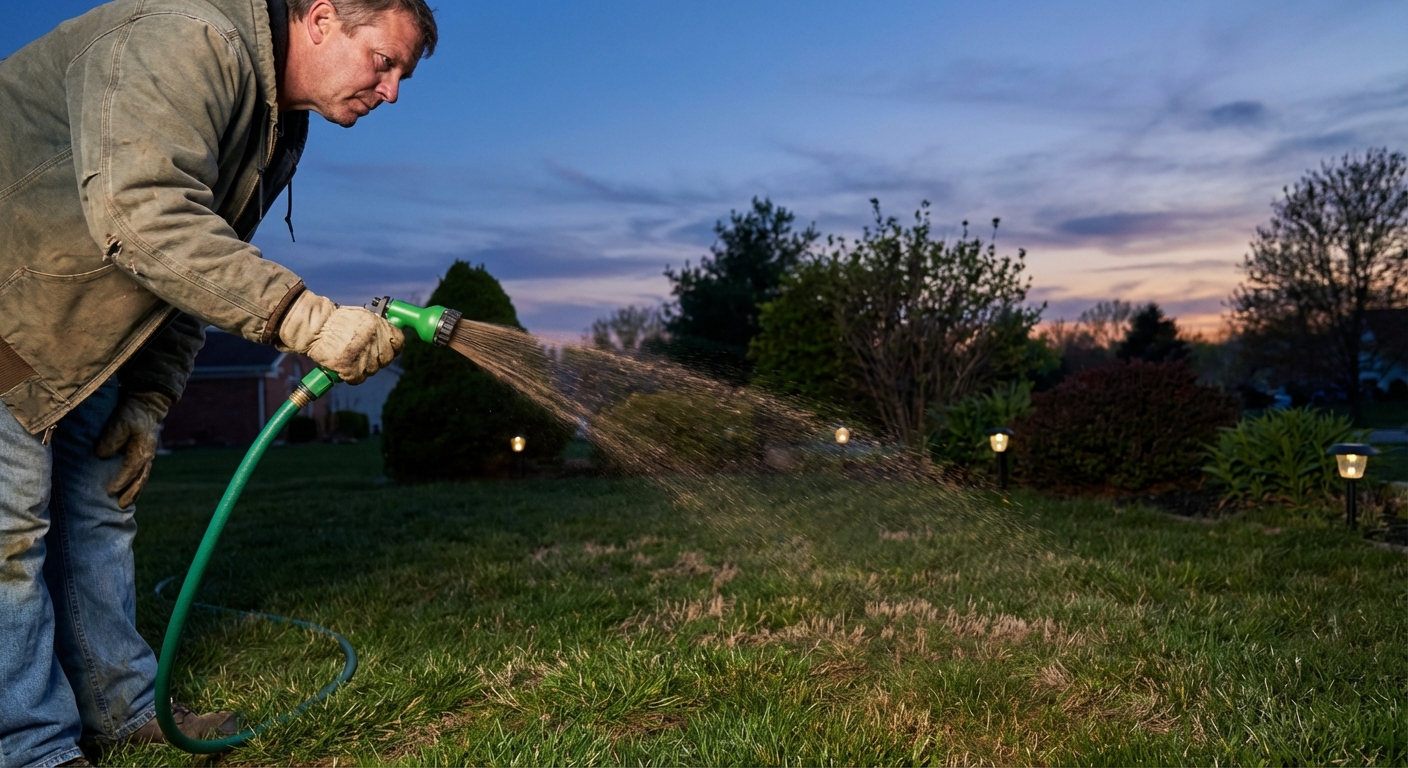
- Apply at the right time of day: early morning or evening. Sunlight can harm them.
- Keep soil moist: water before and after. They need moisture to move through the soil.
- Storage matters: buy from a reputable source, check the expiration, and store as directed (often refrigerated).
Milky spore (Japanese beetles only)
Milky spore is a bacterial disease that targets Japanese beetle grubs. It is not a universal grub killer, so it is important to know your likely beetle species in your area.
- Works best: where Japanese beetles are common.
- Does not help: with chafer grubs and other non Japanese beetle species.
- Timeline: it is not instant. Think seasons, not days.
- Results vary: performance can be uneven by region and soil conditions.
- Upside: once established, it can provide long-lasting suppression with minimal ongoing effort.
Marcus honesty moment: the first time I tried milky spore, I expected it to act like a knockdown insecticide and I was disappointed. Once I treated it like a long-term prevention tool, it made a lot more sense.
Healthy-lawn practices that help
- Water deeply, less often to encourage deeper roots.
- Raise mowing height (most lawns do well around 3 to 4 inches, depending on grass type and season).
- Aerate compacted soil so roots grow stronger.
- Overseed thin spots so you do not have bare areas beetles love to lay eggs in.
What I would do this weekend
1) Confirm grubs with the peel test
Do not treat blind. Check at least two spots: one dead area and one area that is just starting to discolor.
2) Decide: curative now or preventive later
- If you have active damage and a high count, go curative (or nematodes if conditions fit).
- If you have light damage or you are early in the season, plan prevention (GrubEx-type timing).
3) Apply correctly and water it in
Most grub controls fail because they never reach the root zone. Calibrate your spreader, apply evenly, and water according to the label. And remember, more is not better.
4) Repair the lawn after
Once roots are damaged, grass might not bounce back on its own. Plan on:
- Raking out dead turf
- Topdressing lightly with compost or topsoil
- Overseeding or patching
- Keeping seed moist until established
Seasonal schedule
Spring (March to May)
- Inspect for thin areas and repair them early.
- If you had a known grub issue last year, plan your preventive window.
- In some regions, nematodes can work in spring if soil temps are warm enough and grubs are present.
Early summer (May to July)
- Preventive application window: this is typically when products like GrubEx are used (regional timing varies).
- Water in after application.
Late summer to early fall (August to September)
- Peak damage window in many areas.
- Confirm with a peel test.
- Use a curative treatment if counts are high and turf is lifting.
- Beneficial nematodes often perform well in this window if you can keep the soil moist.
Late fall (October to November)
- Grubs tend to move deeper as soil cools, and treatment effectiveness drops.
- Focus on lawn recovery: overseed early enough for your region, and keep leaves from smothering grass.
Winter (December to February)
- Plan ahead. If you dealt with grubs, put a reminder on your calendar for the next preventive window.
FAQ
Will dish soap kill grubs?
Diluted soap solutions are sometimes used as a “flush test” to bring some insects to the surface, but they are not a reliable grub control plan. If you have enough grubs to damage turf, you will usually need a proven curative product or properly applied beneficial nematodes.
Do I need to treat the whole lawn?
Not always. If damage is localized and grub counts are low elsewhere, spot-treating can work. If you find high counts in multiple areas, a full-lawn approach is usually more effective and prevents the patchwork problem from creeping across the yard.
How long until the lawn looks better?
Killing grubs stops the root damage, but grass recovery depends on how much root mass is left. Light damage may green up in a couple weeks with watering. Heavy damage often needs reseeding or sod.
Why are raccoons and skunks tearing up my lawn?
They are often hunting grubs. If you remove the food source, the digging usually slows down.
The takeaway
Grubs are frustrating, but they are also one of the most fixable lawn problems once you match the solution to the season.
- Confirm the problem with a quick peel test.
- Use a curative option when grubs are actively feeding and damage is visible.
- Use a preventive like GrubEx in the right early-season window to stop the next generation.
- Consider nematodes for a natural approach, and milky spore for long-term Japanese beetle grub pressure.
If you want, tell me your general region, whether you have a cool-season or warm-season lawn, and what month it is right now, and I can suggest the most likely best timing for your yard.

About Marcus Vance
Content Creator @ Grit & Home
Marcus Vance is a lifelong DIY enthusiast and self-taught home renovator who has spent the last decade transforming a dilapidated 1970s ranch into his family's dream home. He specializes in budget-friendly carpentry, room-by-room renovations, and demystifying power tools for beginners. Through his writing, Marcus shares practical tutorials and hard-learned lessons to help homeowners tackle their own projects with confidence.