
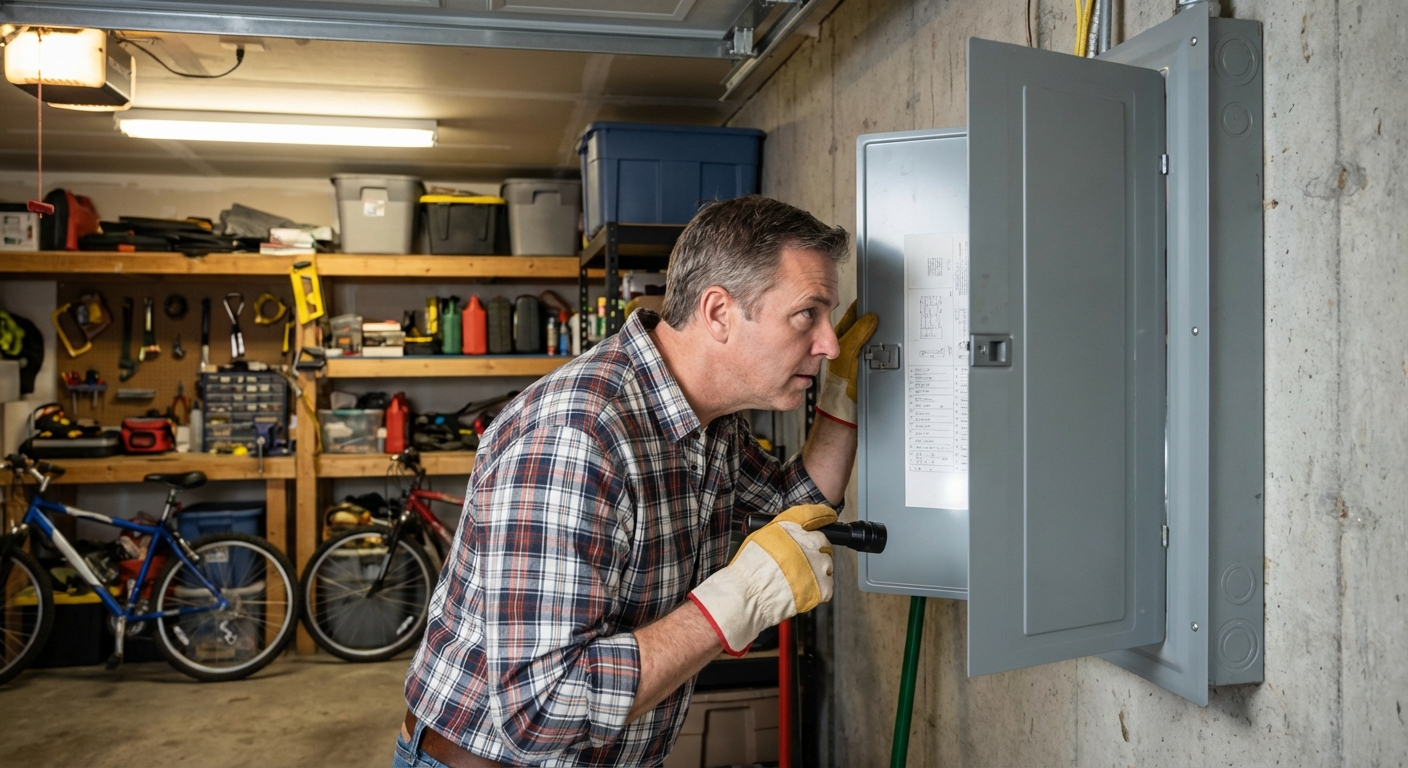
If half the kitchen went dark or your bedroom outlets suddenly stopped working, odds are you have a tripped circuit breaker. It can feel urgent in the moment, but a single trip is often a straightforward fix as long as there are no signs of heat, smoke, or burning.
I have tripped breakers plenty of times while renovating my 1970s ranch. The key is to reset it calmly and correctly, then pay attention to what made it trip in the first place. A breaker is a safety device. When it trips, it is doing its job.
What a tripped breaker means
A standard circuit breaker shuts off power when it senses conditions that could overheat wires or create a shock or fire hazard. Most trips fall into these common buckets:
- Overloaded circuit: Too many things pulling power on the same circuit. Think space heater plus hair dryer, or a vacuum running while the microwave is on.
- Short circuit: Hot wire touches neutral (or another hot) due to damaged insulation, a failed appliance, or a wiring issue. Shorts often trip instantly and can come with a pop, scorch mark, or burnt smell.
- Ground fault: Electricity leaks to ground (often through moisture or a damaged cord). This is what GFCI protection is designed to catch, but some breakers are GFCI breakers and will trip at the panel.
- Arc fault: An AFCI (arc-fault) breaker trips when it detects arcing, which can be caused by loose connections, damaged cords, or sometimes certain motors and devices.
Bottom line: resetting is fine, but repeated trips are a message. Your job is to figure out whether it is a simple overload or something more serious.
Before you touch the panel: a quick safety check
Your breaker panel is safe to operate in normal conditions, but it is not the place to be brave. Use this checklist:
- Stop if you see water on the floor, wall, or panel. Mixing water and electricity is an immediate call-an-electrician situation.
- Stop if you smell burning (electrical, plastic, or “hot dust”), see smoke, or see black soot around the panel.
- Stand on a dry surface and keep one hand free when possible. (Less chance of becoming a path across your chest.)
- Use a flashlight, not your phone with wet hands or while juggling kids and laundry.
- Do not remove the metal cover of the panel. You only need the door open to access breaker handles.
If anything on that list feels questionable, skip the DIY reset and call a licensed electrician.
Quick check: it might be a GFCI outlet
One common homeowner curveball: sometimes “half the kitchen is out” is not the panel at all. It is a tripped GFCI outlet upstream that protects other outlets “down the line.”
- Look for an outlet with TEST and RESET buttons (often in kitchens, bathrooms, garages, basements, outdoors).
- If it is tripped, press RESET. If it will not reset, unplug anything on that circuit and try again.
If you checked the obvious GFCIs and still have dead outlets, then it is time to head to the panel.
How to find the tripped breaker
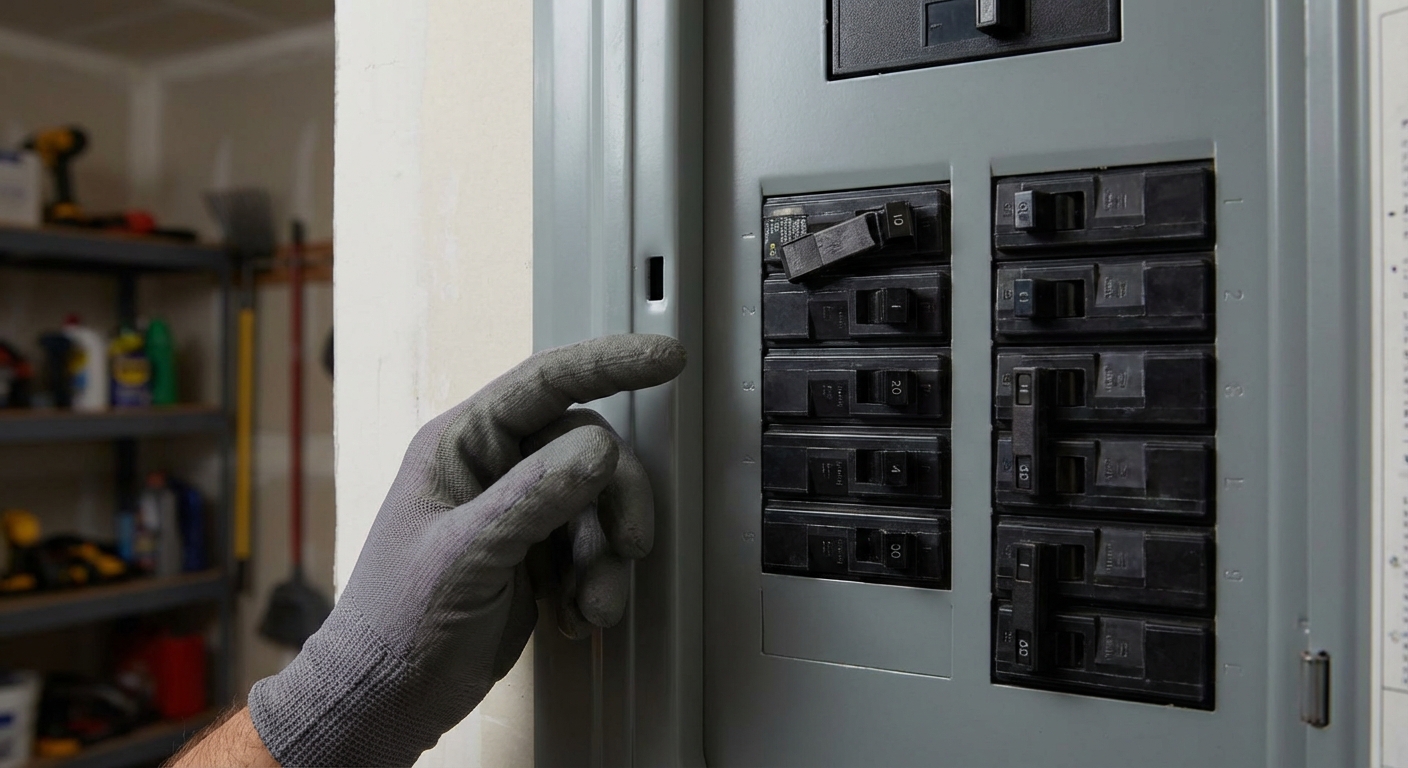
Most homeowners expect the tripped breaker to be fully in the OFF position. A lot of the time, it is not. It often sits in a middle position between ON and OFF.
Step-by-step
- Open the panel door (not the cover) and scan the rows of breakers.
- Look for a handle out of line or a breaker showing a red or orange indicator window (varies by brand).
- Use the panel label as a clue, but do not trust it blindly. In older homes, labels are often “close enough.”
- Confirm by symptoms: if lights are out in one area or outlets are dead, that circuit is likely the one.
Safer tip from too many late-night trips: If you are unsure, do not go hunting by touching every handle. Use the misaligned handle or indicator window first, then confirm based on what lost power.
The correct way to reset a tripped breaker
This is the part most people do wrong. A breaker that tripped needs to be switched fully OFF before it can reset to ON.
Reset steps
- Turn off or unplug the high-draw stuff on that circuit first. Space heaters, hair dryers, window AC units, shop vacs, microwaves, toasters, and power tools are common culprits.
- Move the breaker handle firmly to OFF. You should feel a definite click. If it was in the middle, this is the reset “clear” step.
- Move the breaker back to ON with a firm push.
- Watch it for a moment. If it trips right away with everything still unplugged, do not keep resetting it.
- Restore loads slowly: plug things back in one at a time so you can spot the troublemaker.
If the breaker stays on, you are probably dealing with an overload or a single cranky appliance. If it trips immediately, treat that as a warning sign and move to the troubleshooting section below.
Special note: tied handles and 2-pole breakers
Some breakers are double-wide (2-pole) or have two handles tied together with a bar. These often feed 240-volt appliances (dryer, range, AC) or a multi-wire circuit.
- Treat tied handles as one unit: switch the whole thing fully OFF, then back ON.
- If you are not sure what you are looking at, do not force anything. Get help.
If it trips again: what it is trying to tell you
Common and fixable causes
- Too much on one circuit: You reset it, then you turn everything back on at once, and it trips again.
- One appliance is failing: A microwave, old fridge, sump pump, disposer, space heater, or power tool can develop an internal short and trip a breaker the moment it starts.
- Moisture in the wrong place: Outdoor outlets, garage outlets, bathrooms, and kitchens can trip protection devices when moisture gets into a cord end or box.
Red flags to take seriously
- Burning smell at the panel, outlet, or appliance.
- Buzzing, sizzling, or crackling sounds.
- Unusual warmth or heat from the breaker, panel, outlet, or plug. If it is noticeably warm, hot, or uncomfortable to touch, that is a hard stop.
- Visible damage: scorch marks, melted plastic, discolored outlet cover, charred cord end.
- Breaker will not stay on with everything unplugged.
- Lights dimming or flickering in multiple areas, or multiple breakers tripping.
Those are the situations where “I will keep flipping it and hope” can turn into an expensive, dangerous problem. Call a licensed electrician.
Simple troubleshooting flow
Use this quick flow to narrow it down without guessing. Your goal is to identify whether it is an overload, an appliance problem, or a wiring fault.
-
Check for danger signs.
- If there is burning smell, smoke, buzzing, sizzling, or heat at the panel or outlets: leave the breaker OFF and call an electrician.
-
Reset correctly.
- Turn loads off, push the breaker fully to OFF, then back to ON.
-
If it trips immediately:
- Unplug everything on that circuit and turn off any switched loads.
- Reset again (OFF fully, then ON).
- If it still trips with everything unplugged: likely breaker or wiring fault. Call an electrician.
- If it holds: plug items in one at a time until you find the one that trips it. Stop using that item or cord.
-
If it holds:
- Turn on appliances one at a time.
- If it only trips when several are running: overload. Redistribute loads or ask an electrician about a dedicated circuit.
- If trips seem random: document what was running and consider calling an electrician.
Thrifty homeowner note: An overload fix is usually behavioral first. Stop stacking big loads on one circuit. If that is not realistic (like a microwave sharing with countertop outlets), that is when you talk to an electrician about adding a dedicated circuit.
Special cases: GFCI and AFCI breakers
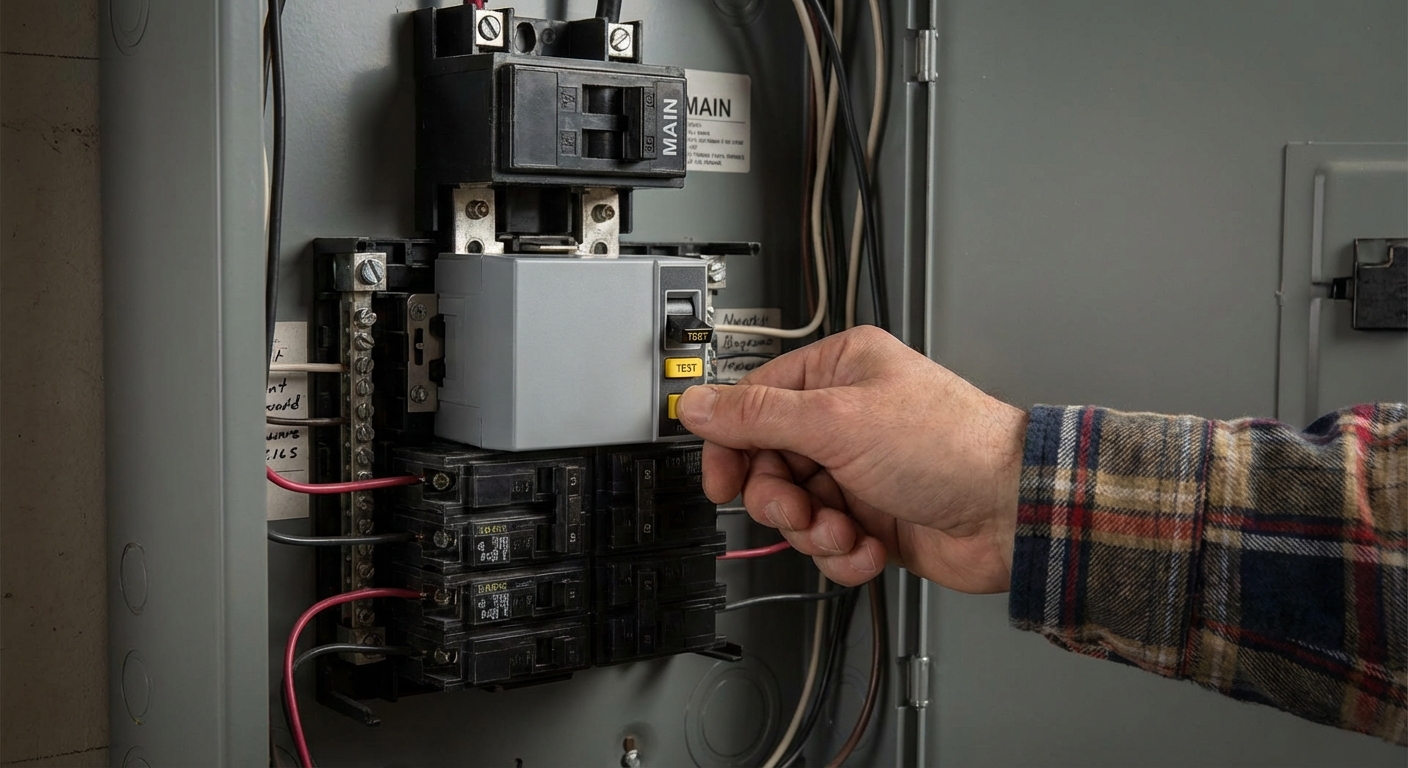
Depending on your home’s age and location, the breaker that tripped may be a GFCI (ground-fault) breaker, an AFCI (arc-fault) breaker, or a dual-function breaker. These are extra protective and sometimes more sensitive than older standard breakers.
- GFCI breaker: Common for garages, outdoors, bathrooms, kitchens, laundry areas. Trips from moisture, damaged cords, or ground faults.
- AFCI breaker: Often used for bedrooms and living areas. Trips if it detects arcing, which can happen with loose connections, damaged cords, or sometimes with certain motors and older devices.
Many of these breakers have a TEST button. You usually still reset them the same way (OFF fully, then ON). If a GFCI or AFCI breaker trips repeatedly and you cannot tie it to one device, bring in an electrician. Arc faults in particular can be a sign of a loose connection that needs to be found and fixed.
When to stop DIY and call an electrician
Here is my simple rule: resetting once is troubleshooting. Resetting over and over is ignoring a safety device.
Call an electrician if:
- The breaker trips immediately even with all loads unplugged.
- The breaker handle feels loose, will not click, or will not stay in ON.
- You see heat damage, smell burning, or hear buzzing or sizzling.
- Outlets are unusually warm, discolored, sparking, or making crackling sounds.
- The same circuit has tripped multiple times in a short period.
- You have an older panel and you are seeing multiple odd issues (flicker, frequent trips, hot spots).
If you are ever in doubt, err on the safe side. Electrical problems are one of the few home issues where “wait and see” can get expensive fast.
Quick FAQ
Is it safe to reset a breaker?
Yes, if the area is dry, there are no burning smells or signs of damage, and you reset it properly (OFF fully, then ON). If it trips repeatedly, that is no longer a simple reset situation.
Why does my breaker trip when I turn on one specific thing?
That points to a failing appliance, a damaged cord, or a device that is too large for that circuit. Stop using the device until you can confirm the cause.
Why is the breaker not all the way OFF when it trips?
Many breakers trip to a middle position. That is normal. You still need to push it firmly to OFF before it will reset.
Can a breaker go bad?
Yes. Breakers can weaken over time or fail. If it will not reset or it trips with everything unplugged, an electrician can test and replace it if needed.
My simple homeowner takeaway
Flip it once, thoughtfully. If it holds, great, you probably had an overload. If it trips again, unplug and isolate. If it still trips, or you notice any heat, smell, sound, or scorch marks, leave it off and call in help.
That is not being overly cautious. That is letting the safety device do its job while you keep your house and family safe.

About Marcus Vance
Content Creator @ Grit & Home
Marcus Vance is a lifelong DIY enthusiast and self-taught home renovator who has spent the last decade transforming a dilapidated 1970s ranch into his family's dream home. He specializes in budget-friendly carpentry, room-by-room renovations, and demystifying power tools for beginners. Through his writing, Marcus shares practical tutorials and hard-learned lessons to help homeowners tackle their own projects with confidence.