
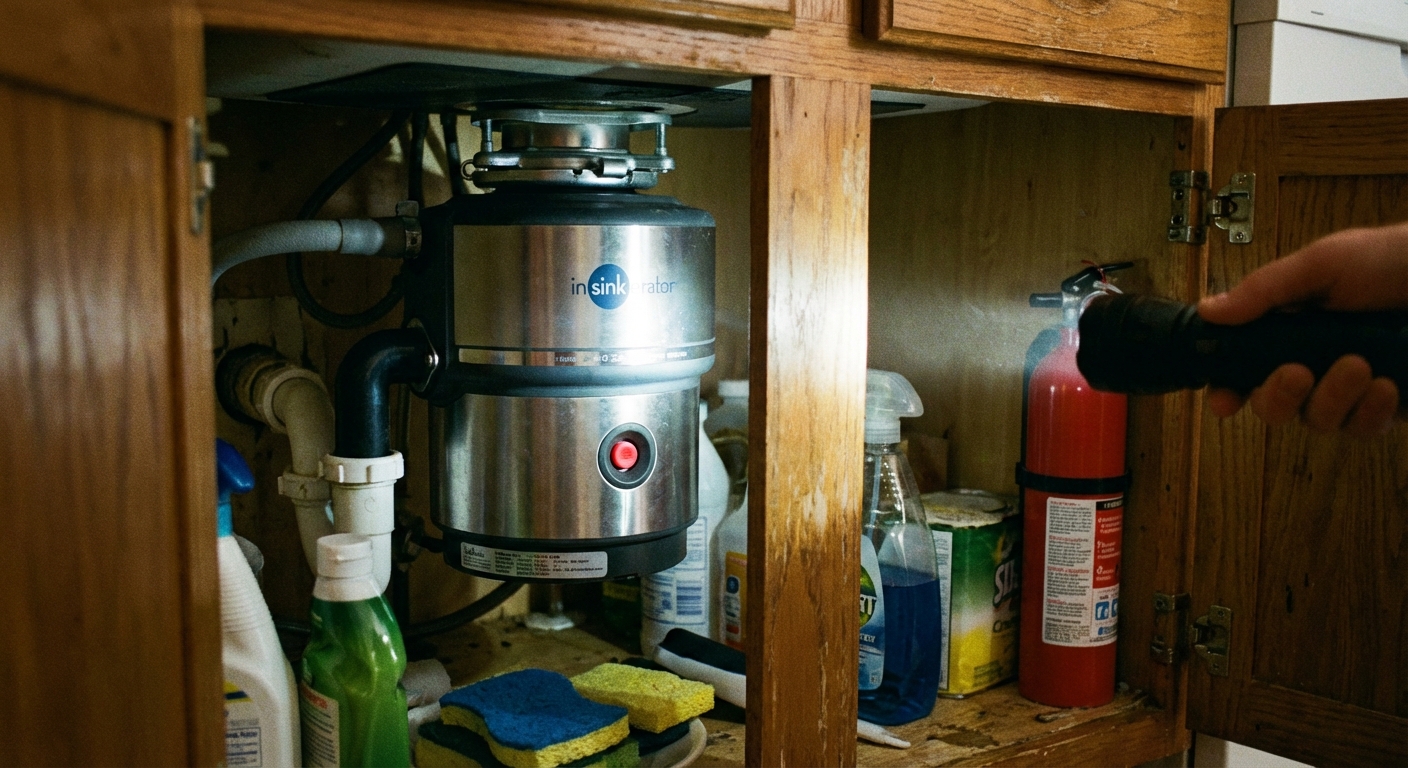
A garbage disposal that hums but will not spin is most often not a wiring problem. In many cases it is a jam: something is physically preventing the impeller plate from turning. The good news is that most jams are fixable in 10 to 20 minutes with a little patience and the right safety steps.
I have freed more than a few disposals in my 1970s ranch. My first time, I did the classic rookie move and kept flipping the switch while it hummed. That can trip the overload, overheat the motor, and accomplish nothing. Let’s do it the calm, safe way.
Before you touch anything: safety rules
Garbage disposals are small, powerful motors attached to sharp metal parts. Treat them like a power tool you cannot fully see.
- Turn power off first. Switch the wall switch off, then unplug the disposal under the sink. If it is hardwired, turn off the correct breaker.
- Never put your hand inside the disposal. Not for “just one second.” Use tongs, pliers, or a tool.
- Let it cool if it was humming. Give it a few minutes. If the reset button popped, you will still need to press it later.
- Use a flashlight. You want to see what you are doing. Phone flashlights work great.
- Skip hot water while troubleshooting. Use cold water for testing. Hot water can soften fats and move them downstream where they re-solidify and contribute to clogs.
Quick diagnosis
If it hums but won’t spin
This is the classic jam or a unit that is struggling to start. The motor is getting power and trying to turn, but something is blocking the impeller plate, or the motor is seized. Your goal is to manually free the rotation and clear the obstruction.
If it is silent (no hum)
That is usually power related or a tripped overload. Start simple: check that it is plugged in, check for a tripped GFCI outlet, verify the breaker is on, and press the reset button if it is popped. If it is totally dead after that, you may be on a different troubleshooting path than a basic jam.
Tools and supplies
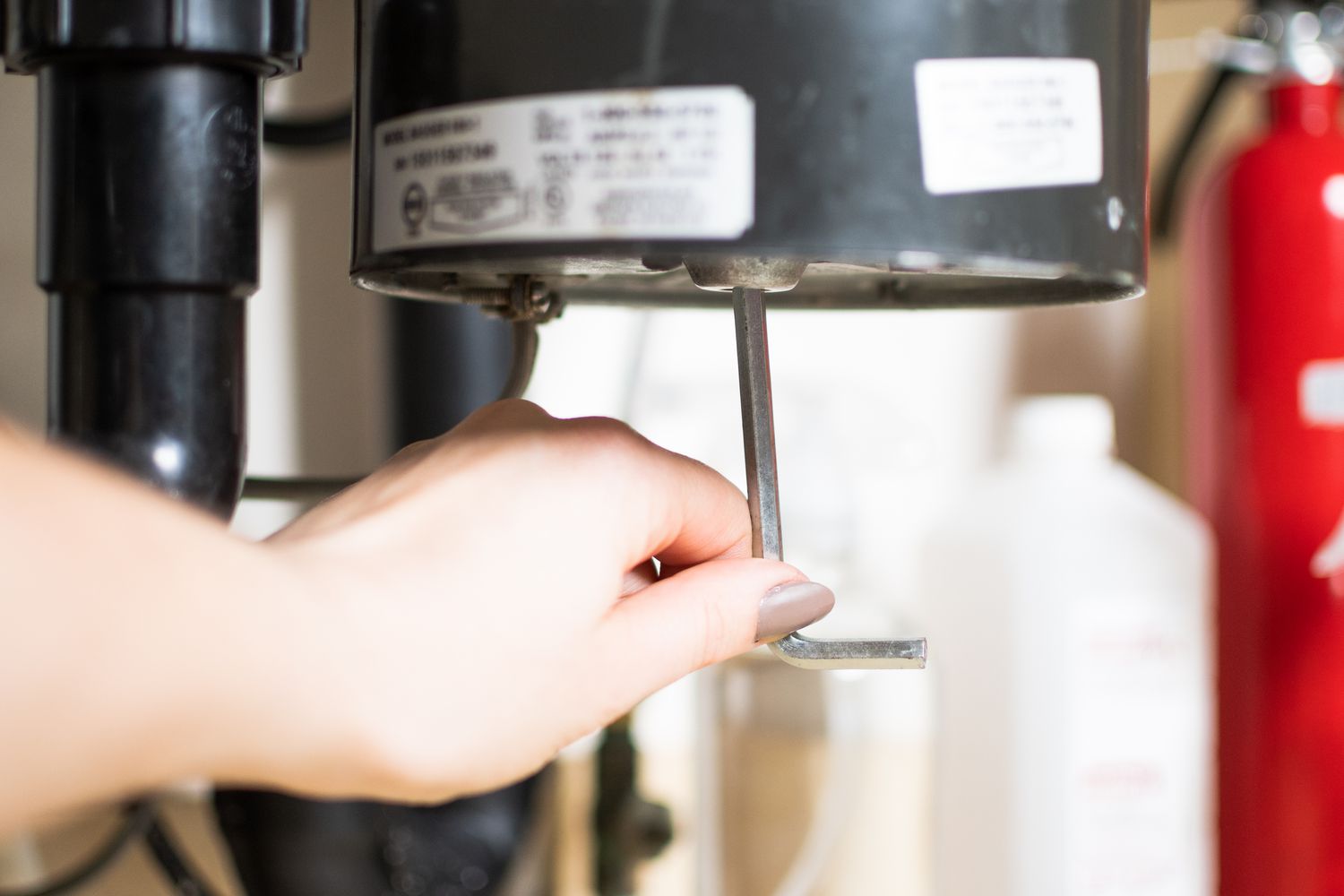
- Allen wrench (hex key) that fits your disposal (commonly 1/4 inch on many InSinkErator-style units, but it varies by brand and model)
- Or the manufacturer’s jam-buster wrench tool if your unit came with one
- Flashlight
- Needle-nose pliers or kitchen tongs
- Small bucket or towel (optional, but nice)
Tip: Many disposals ship with a hex key or jam tool. If you do not have it, a basic Allen wrench set is cheap and earns its keep around the house. When in doubt, check your manual or look up your model number.
Step-by-step: unjam with a hex wrench
This is the method I use most often because it works without sticking anything down into the grinding chamber.
1) Cut power and confirm it
Unplug the disposal or turn off the breaker. With it unplugged or the breaker off, flip the wall switch once to confirm nothing happens.
2) Find the hex socket on the bottom
Crawl under the sink with a flashlight. In the center of the disposal base there is usually a hex-shaped socket. (If you do not see one, skip ahead to the wooden spoon method or use your manufacturer’s jam tool.)
3) Work it back and forth
Insert the hex key fully, then rotate it back and forth. You might feel it stop hard at first. That is normal.
- Start with short movements to “break” the jam.
- As it loosens, rotate farther each time.
- You will usually feel the resistance suddenly lessen, and the wrench will turn more freely in both directions.
- If it will not budge at all, do not force it like you are tightening lug nuts. Use steady pressure, then move on to check for debris.
4) Remove the obstruction (tools only)
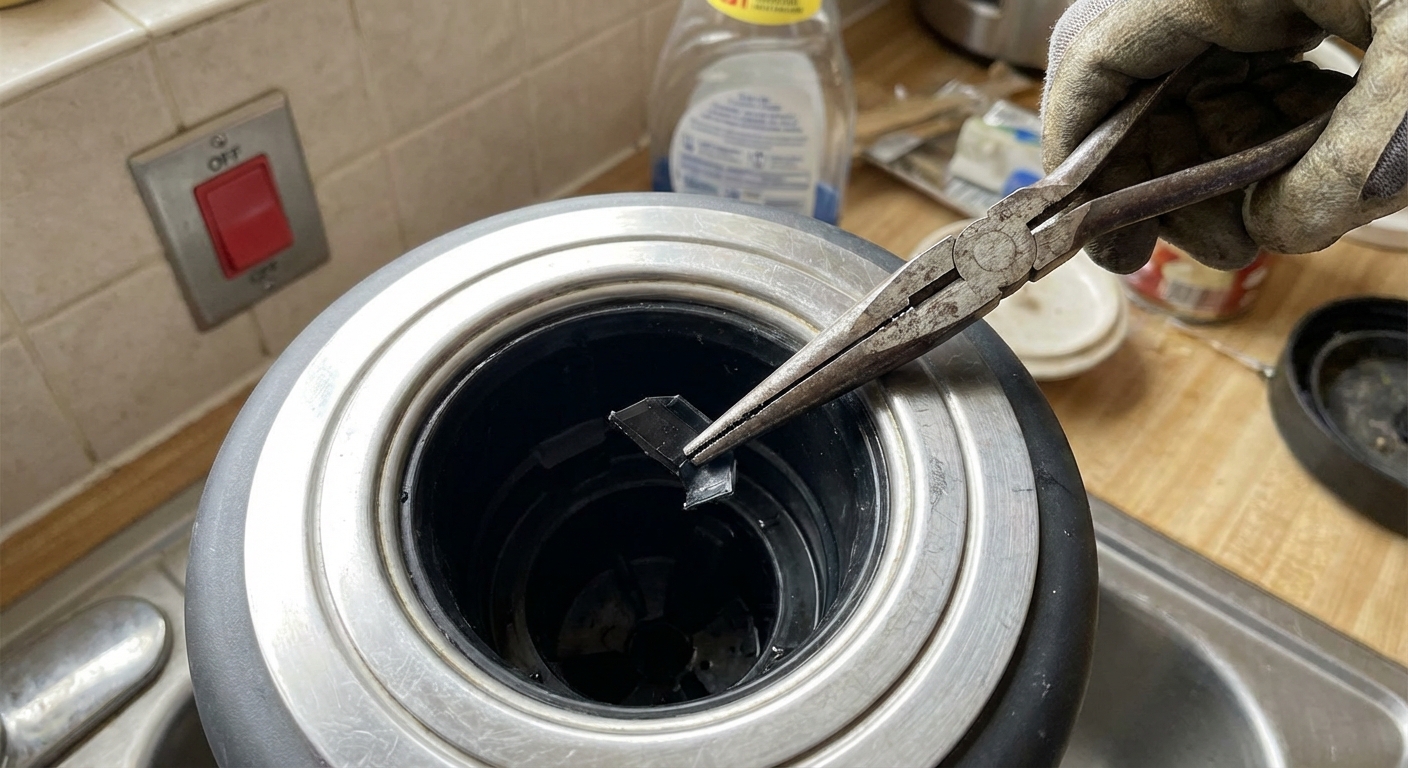
From above the sink, shine a light down and look for the culprit. Common offenders include:
- Fruit pits (peach, avocado)
- Bones
- Silverware, especially teaspoons
- Bottle caps and pull tabs
- Thick fibrous scraps (corn husk, celery, onion skins)
Use tongs or pliers to pull debris out. Again, no hands.
5) Press the reset button
Under the sink, find the small reset button on the disposal body, usually red. If it popped out, press it back in until it clicks.
6) Restore power and test with cold water
Plug it back in or flip the breaker on. Run cold water and then switch the disposal on for a short test.
- If it spins normally, let it run 10 to 15 seconds with water to flush the chamber.
- If it hums again, turn it off immediately and go back to manual rotation. Something is still stuck, or the motor is struggling to start.
No hex socket? Try a wooden spoon
Some models do not have a hex socket on the bottom, or it is inaccessible. You can sometimes free the impeller from above.
- Power off and unplug first.
- Use a wooden spoon handle or a thick wooden dowel.
- Press the handle down into the rubber splash guard and gently nudge the impeller plate back and forth.
If it starts moving, you are on the right track. Once it turns freely, remove debris with tongs, press reset if needed, then test with cold running water.
If it won’t turn by hand
If the disposal will not rotate with the hex key or spoon method, stop. At that point, you may be dealing with something wedged tightly between the impeller and the grind ring, seized bearings, or a failing motor (some models can also have start components that quit).
- Double-check power is off.
- Look carefully with a flashlight for a solid object you can grab with tongs.
- If you cannot see or remove anything and it still will not rotate, it is time to call a plumber or plan for replacement.
How to clear stuck food debris
A jam is often a single hard object, but sometimes it is a wad of food fiber that packs in tight. Here is how to clear it without making a bigger mess.
What to do
- Scoop and grab: Use tongs to pull out big clumps first.
- Flush with cold water: After the unit spins again, run cold water to help carry debris out.
- Cut fibrous scraps small: If you insist on sending peels or celery through, keep amounts tiny and let water run well before and after.
What not to do
- No drain chemicals. Caustic cleaners can splash back and do not solve a mechanical jam.
- No hands inside. Even with power off, sharp edges and trapped objects can cut you.
- Do not keep running it while it hums. A stalled motor draws high current and can overheat and damage the unit.
Why the reset button matters
The reset button is an overload protector. When the motor strains, it can trip to prevent damage. A common sequence is:
- Disposal jams
- You hear a hum
- It trips and becomes silent
That is why it is smart to unjam first, then hit reset, then test. If you only press reset without freeing the jam, it may just trip again.
Troubleshooting
- Hums, no movement: Usually a jam or a unit struggling to start. Free the rotation with a hex key, clear debris, then reset.
- Clicks off quickly: Overload tripping due to a jam or a failing motor. Unjam and reset. If it keeps happening, consider replacement.
- Turns, but drains slowly: Could be a partial clog in the disposal, the P-trap, or the branch line. Do not assume the disposal is the only problem.
- Grinding metal sound: Likely a foreign object like a spoon or bottle cap. Shut it off and remove with tongs.
When to call a plumber
I am all for DIY, but here are the moments I stop and either call a pro or plan for a new unit.
Call a plumber if:
- You see leaks from the disposal body, seams, or bottom (often a sign the unit is failing internally).
- The disposal is freed, but the sink still backs up quickly, suggesting a clog deeper in the drain line.
- You find melted wiring, a burning smell, or a breaker that trips repeatedly even after unjamming.
- The unit is hardwired and you are not comfortable working around electrical connections.
Consider replacement if:
- It is older and has frequent jams or trips.
- It is noisy in a new way, leaks from the housing, or struggles even with soft scraps.
- Manual rotation feels rough or gritty even after clearing debris, which can point to internal wear.
- It will not rotate at all with the hex key, even after you have removed anything obvious.
How to prevent future jams
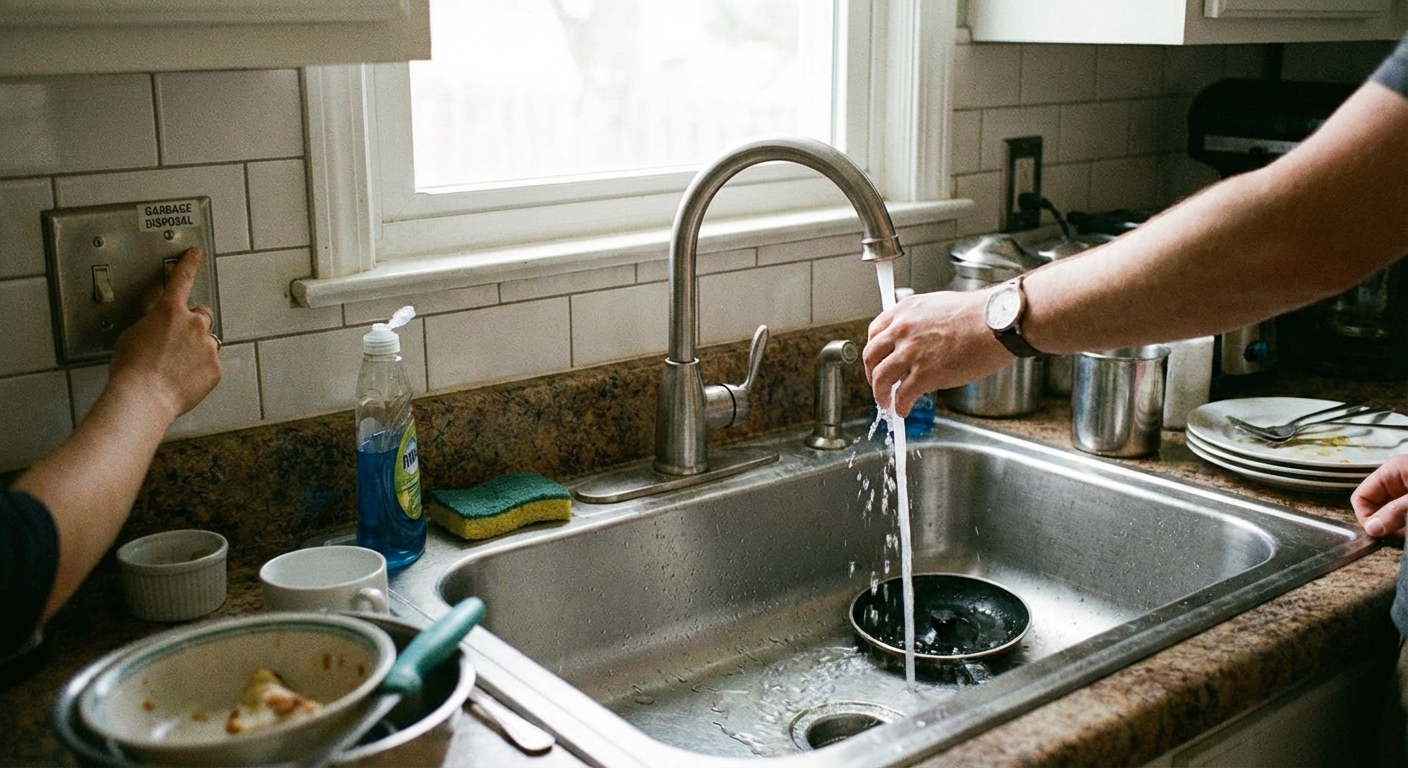
- Run cold water before, during, and for 10 to 15 seconds after using the disposal.
- Feed small amounts. Think a few bites at a time, not a whole plate scrape in one drop.
- Avoid fibrous and starchy loads. Celery, corn husks, onion skins, potato peels, and pasta can tangle or swell.
- Keep grease out. Grease solidifies downstream and turns into a clog you will not enjoy meeting later.
- Listen for change. A new hum or sluggish start is your early warning sign to stop and check before it becomes a full jam.
Fast checklist
- Power off and unplug (or breaker off)
- Manual rotation with hex key, jam tool, or wooden spoon handle
- Remove debris with tongs or pliers
- Press reset button if it popped
- Test with cold running water
If you get stuck, do not keep forcing it. A disposal you cannot free with manual rotation often has something wedged hard or an internal failure, and that is when calling a plumber is money well spent.

About Marcus Vance
Content Creator @ Grit & Home
Marcus Vance is a lifelong DIY enthusiast and self-taught home renovator who has spent the last decade transforming a dilapidated 1970s ranch into his family's dream home. He specializes in budget-friendly carpentry, room-by-room renovations, and demystifying power tools for beginners. Through his writing, Marcus shares practical tutorials and hard-learned lessons to help homeowners tackle their own projects with confidence.