
🚨 In a DIY emergency or rush?
Skip the details and jump straight to our 30-second cheat sheet for the most crucial info.
If you are about to replace a wax ring because your toilet rocks or you have a mystery leak, pause for a minute and look at the closet flange first. That flange is the anchor point for the whole toilet. If it is cracked, broken at the bolt slots, sitting too low, or screwed into soft, rotted subfloor, a fresh wax ring can fail in days.
I learned this the hard way in our 1970s ranch. I installed a brand-new wax ring, felt proud, and then watched the toilet start to wiggle again within a week. The wax was not the problem. The flange had nothing solid to hold onto.
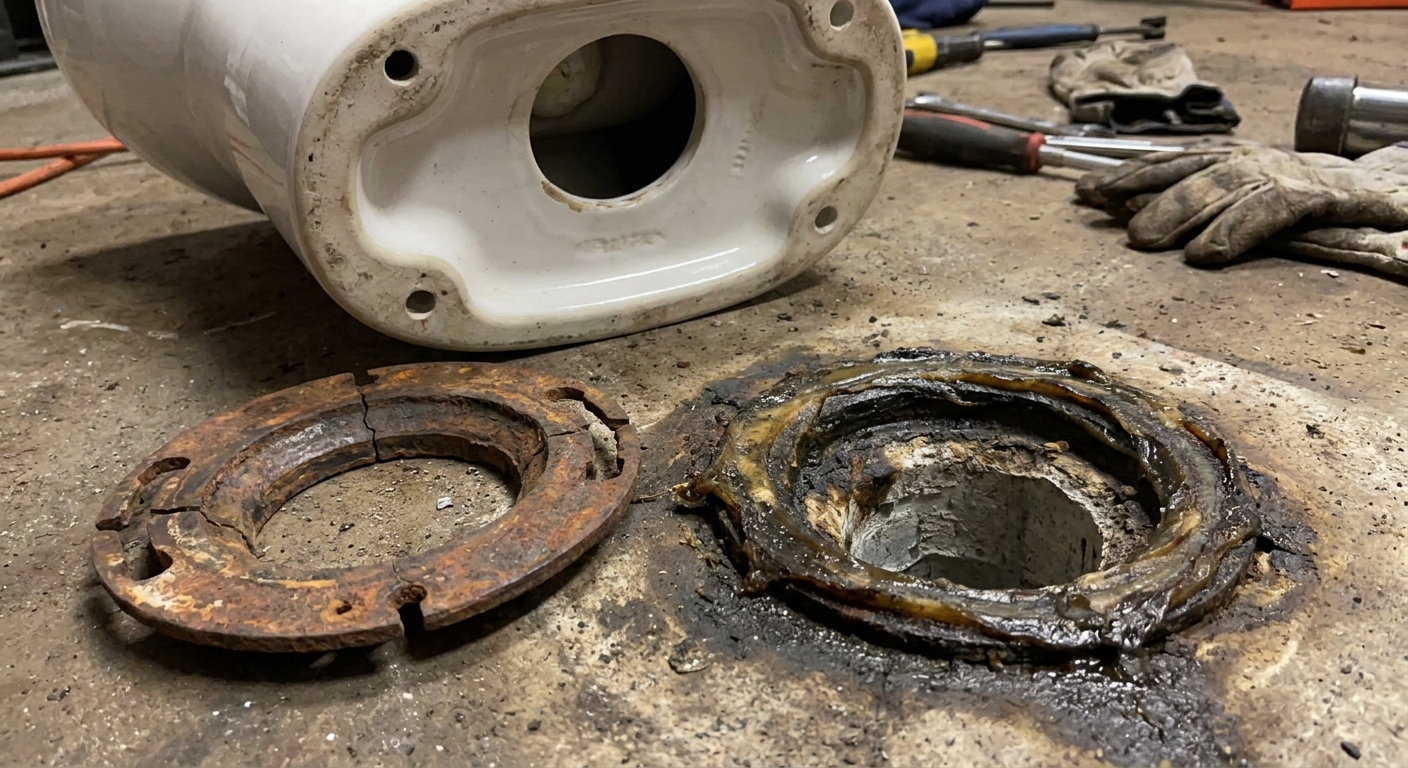
This guide walks you through how to spot a damaged flange, what you can repair in place, what needs a full replacement, and the right sequence to finish with a wax ring that actually seals.
What a toilet flange is and why it fails
The closet flange is the fitting that connects your toilet to the drainpipe and bolts the toilet to the floor. Most flanges are PVC, ABS, or cast iron, with a ring (sometimes metal) that holds the closet bolts.
Why flanges crack or rot out
- Loose toilet movement over time (wax compresses, bolts loosen, toilet rocks, flange gets stressed).
- Corrosion on metal rings, especially in humid bathrooms or after long-term minor leaks.
- Rotted subfloor from a slow leak that went unnoticed.
- Bad flange height (too high or too low), which prevents the toilet from seating correctly and puts stress on the ring.
- Overtightened closet bolts that crack plastic rings or pull through weakened slots.
Signs the flange is the problem
Wax rings fail, sure. But flange issues tend to leave a few specific clues.
1) Toilet rocks even after tightening
If you snug the nuts and the toilet still shifts, the flange may be cracked, the bolt slots may be broken, or the screws holding the flange to the floor may be stripped into soft wood.
Quick reality check: A perfectly good flange can still rock if the floor is uneven or the toilet is not shimmed correctly. Keep that in mind before you assume the flange is toast.
2) Closet bolts will not stay tight
If the bolts spin, tilt, or pull upward when you tighten the nuts, the bolt slots in the flange ring may be broken.
3) Cracks or broken bolt slots
Once the toilet is removed, inspect the ring closely. A hairline crack near a bolt slot can be enough to cause repeat leaks and wobble.
4) Flange height is off
Target the flange so the top of the flange sits about 1/4 inch above the finished floor and is anchored on top of the floor. Flush to the floor is usually workable. If it is more than about 1/4 inch below the finished floor, that is when extenders are generally the cleaner fix than trying to stack wax.
How to check: Lay a straightedge across the finished floor next to the opening and measure up (or down) to the flange top. You are not chasing lab precision here, just whether you are in the ballpark or clearly too low.
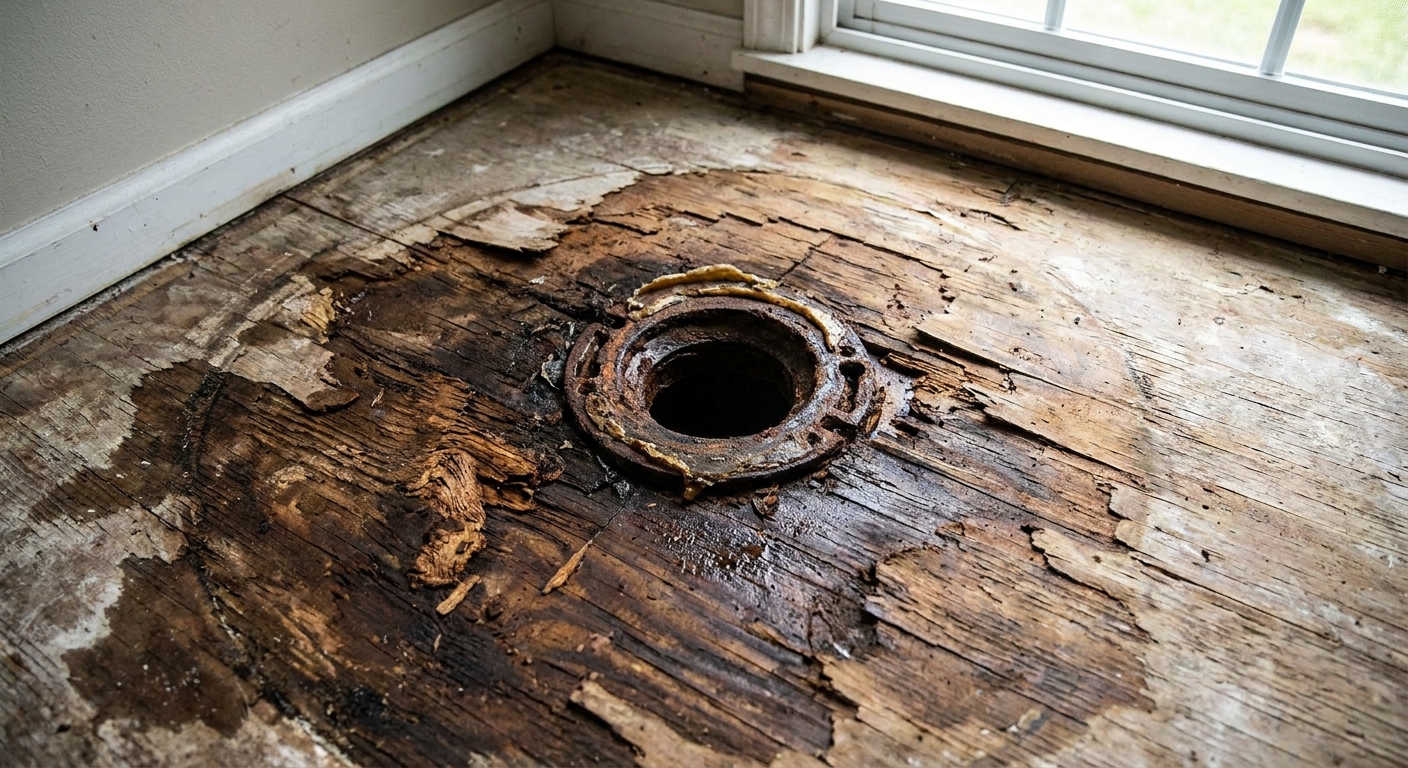
5) Soft or crumbly subfloor
Probe gently with a screwdriver. Solid wood feels firm. Rotted wood gives easily, flakes, or looks blackened. If the flange screws will not bite, the floor may need repair before you reinstall the toilet.
Before you start
Tools and supplies (pick based on what you find)
- Adjustable wrench or deep socket for closet bolt nuts
- Putty knife for scraping old wax
- Gloves and a bucket or towels
- New wax ring (wax only, or wax with horn, or wax-free gasket)
- New closet bolts and nuts (recommended)
- Flange repair ring or split repair ring (stainless if possible)
- Flange extender/spacer kit with longer screws (if flange is low)
- Plastic toilet shims (not wood)
- Drill/driver and bits
- Wood screws suitable for subfloor blocking (often 2 to 2.5 inches)
- Oscillating tool or saw (only if you are cutting out rotted subfloor)
Safety note: If your bathroom has older flooring and you suspect asbestos (some vinyl products pre-1980s), do not sand, grind, or aggressively scrape it. Disturbance can also happen when prying up old vinyl, underlayment, or adhesive. Work carefully, or get it tested.
Remove the toilet and inspect
Step 1: Shut off and drain
- Turn off the toilet supply valve.
- Flush, then hold the handle down to drain as much as possible.
- Sponge out the remaining water from the tank and bowl into a bucket.
Step 2: Disconnect and unbolt
- Disconnect the supply line.
- Pry off the bolt caps, remove nuts and washers.
Step 3: Lift straight up
Rock gently side to side to break the wax seal, then lift. Toilets are awkward and heavier than they look, so grab a helper if you can. Set the toilet on an old towel or cardboard.
Step 4: Plug the drain
Stuff a rag into the drain opening to block sewer gas and keep screws from falling in.
Step 5: Scrape and inspect
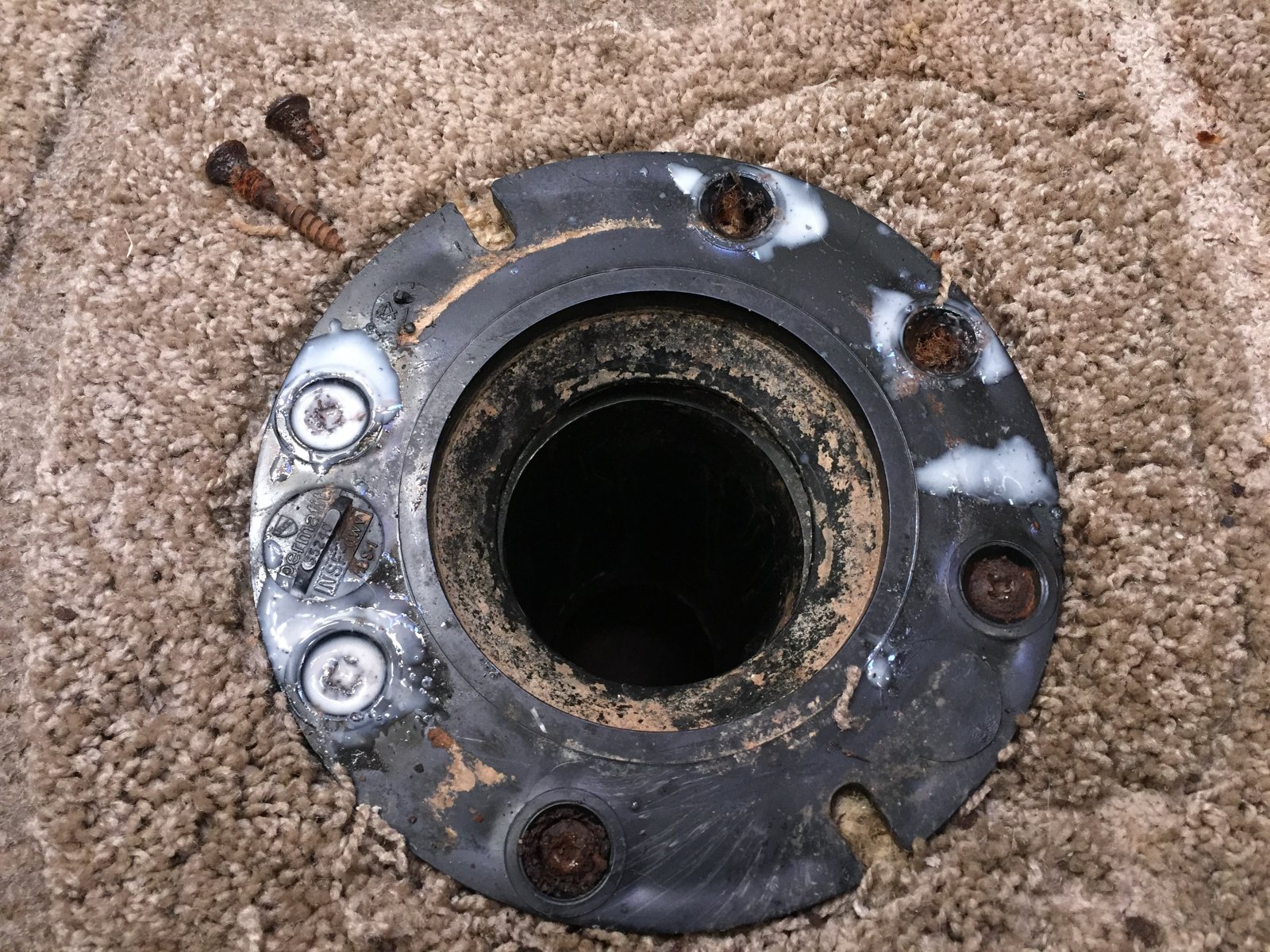
Scrape off old wax so you can see the ring clearly. Look for cracks, broken slots, corrosion, and whether the flange is tight to the floor.
Repair or replace?
Here is the practical decision tree I use in my own house.
Repair in place is common if
- The drainpipe connection is solid and not cracked.
- The flange body is intact but the ring or bolt slots are damaged.
- The flange is only low enough to correct with an extender (not wildly below the floor).
- The subfloor is solid, or can be made solid with blocking and new screws.
Replace the flange if
- The flange body itself is cracked or missing sections.
- The flange is severely corroded or deformed.
- The flange is not properly attached to the drainpipe.
- There is major subfloor rot that requires cutting back to clean, solid wood anyway.
- The flange sits so far below the finished floor that you would need to stack extenders excessively to get back to a solid, rigid setup.
Rule of thumb: If you cannot make the flange rigid and close to the right height, the wax ring is going to lose the fight.
Repair option 1: repair ring
A repair ring is a metal ring that screws down over the existing flange and gives you new, strong bolt slots. This is my go-to when the plastic ring is cracked or the slots are blown out.
How to do it
- Dry fit the repair ring so the bolt slots land at the right orientation (toilet bolts typically sit at roughly 3 o'clock and 9 o'clock).
- Mark screw locations, avoiding the drain opening and any weak, crumbling wood.
- Pre-drill if needed.
- Screw the ring into solid subfloor with stainless or coated screws. If you can catch blocking or a joist edge, even better.
Marcus tip: If the subfloor around the opening is questionable, add blocking from below (if you have access) or cut and patch from above. A repair ring screwed into soft wood is just a nicer-looking failure.
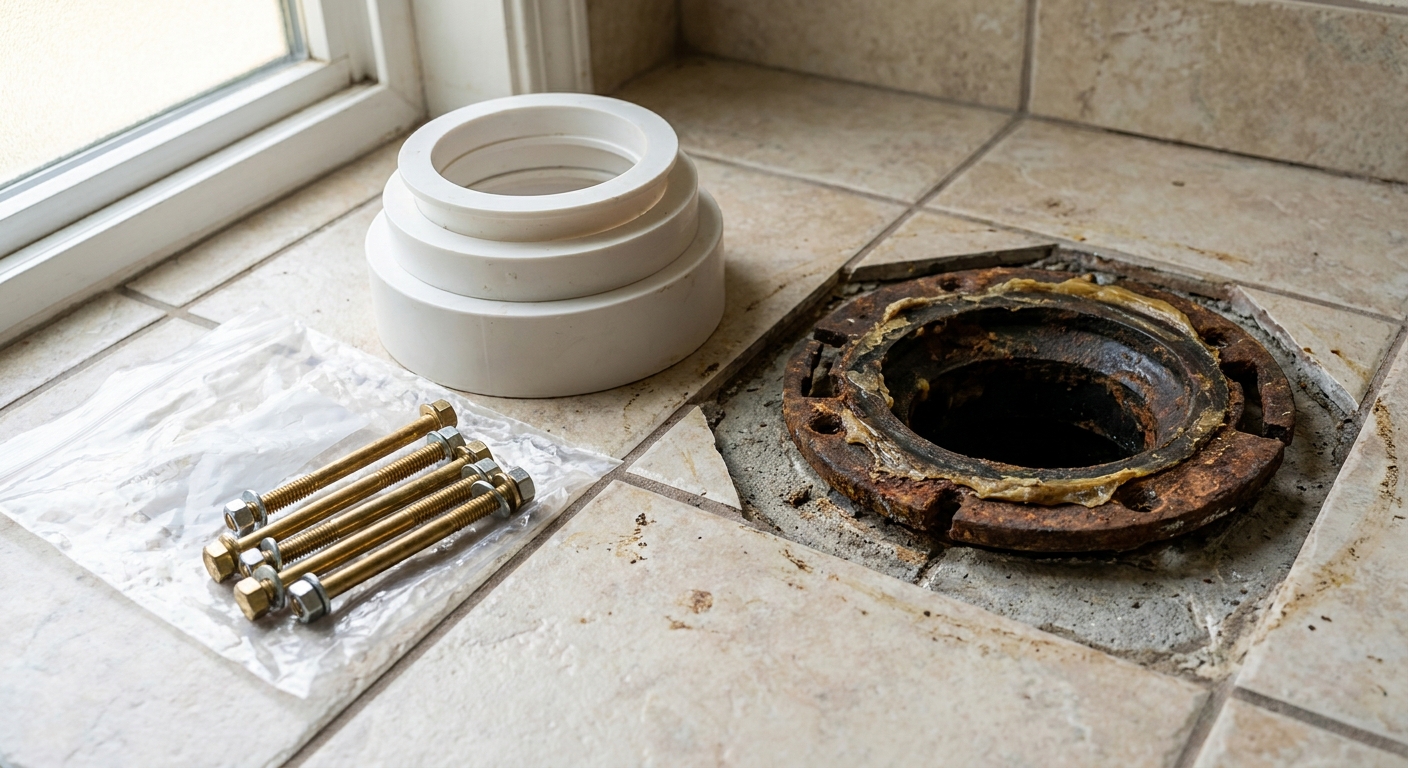
Repair option 2: extenders
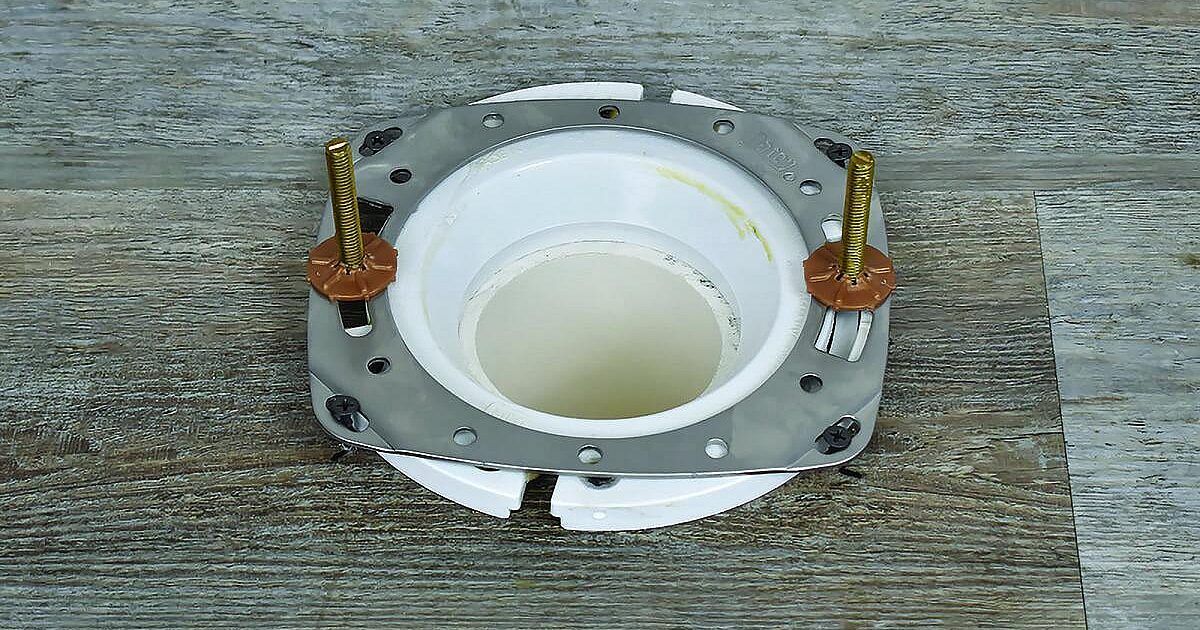
If your flange sits below the finished floor, the wax ring has to bridge a bigger gap. That often leads to a weak seal and repeat leaks. Flange extenders raise the sealing surface so the toilet outlet compresses the wax correctly.
When to use an extender
- You added new tile or thicker flooring and the flange ended up low.
- The flange is intact and secure, just not at the right height.
- As a practical threshold, if the flange top is more than about 1/4 inch below the finished floor, extenders are usually the better move than extra-thick wax.
Common mistakes to avoid
- Stacking too many extenders without securing into solid wood. If it flexes, it leaks.
- Using short screws that only grab the old flange and not the subfloor or blocking.
- Skipping the gasket or sealant recommended by the extender manufacturer.
Repair option 3: fix the subfloor
Sometimes the flange is fine. The floor is not. If the toilet leaked for months, the plywood around the flange can become crumbly and structurally unsound. In that case, your best repair is carpentry first, plumbing second.
What a solid fix looks like
- Cut out all soft material back to solid wood.
- Add blocking between joists (from above or below) so the patch has support.
- Install a plywood patch of the same thickness as the existing subfloor.
- Reattach the flange through the finished floor into solid structure.
When to call a pro: If the rot extends into joists, or you see mold and water damage spreading beyond the toilet area, it is worth getting a contractor or plumber involved. Structural wood is not the place to gamble.
Flange replacement basics
Full replacement can be manageable, but it is not always a friendly DIY job, especially with limited access. The approach depends on your drain material and how the flange is connected.
PVC or ABS drains
Many modern flanges are glued to the pipe (solvent welded). Replacement may require cutting the old flange out and installing a new flange, or using a repair flange that fits inside the pipe.
Cast iron drains
Older homes may have cast iron with lead and oakum joints, or a mechanical style flange. These replacements often require specialized tools and careful technique, and access matters a lot.
My honest advice: If you open this up and discover cast iron with heavy corrosion, or you are unsure how the joint is made, a plumber visit can be money well spent. One wrong cut can turn a small leak into a big drain repair.
Correct order
Here is the order that prevents repeat leaks.
1) Make the flange rigid
Repair ring, extenders, new screws into solid wood, subfloor patching. Whatever it takes, the flange should not flex when you press on it.
2) Set new closet bolts
Install new bolts in the flange slots. They should stand straight up and not wobble. Many kits include plastic retainers that keep bolts from tipping during installation.
3) Choose the right seal
- Standard wax ring: Best when flange height is close to correct and the toilet sits firmly.
- Extra-thick wax ring: Can help when the flange is just a bit low. If you are more than about 1/4 inch low, I would rather raise the flange with an extender.
- Wax ring with horn: Can help guide flow, but compatibility depends on flange design, inside diameter, and alignment. If the horn crowds the opening or does not sit cleanly, skip it and use standard wax (or raise the flange correctly).
- Wax-free gasket: Nice for resets, but it still needs a solid flange and decent height to work well.
4) Set the toilet without sliding
Lower the toilet straight down onto the bolts. Do not slide it around once it contacts the wax. Press down with body weight to compress the seal.
5) Tighten evenly
Alternate side to side. Snug, then stop. Porcelain cracks are expensive lessons.
6) Test for leaks
- Reconnect the supply.
- Turn the water on and let the tank fill.
- Flush several times while checking around the base and below (if you can access from a basement or crawlspace).
Caulk or not?
This is the question everyone asks. Many pros run a thin bead of caulk around the base to keep mop water and spills from going under the toilet. A common compromise is to caulk the front and sides but leave a small gap at the back so a leak shows itself instead of hiding.
Do not use caulk to "stabilize" a rocking toilet. Fix the movement first with a solid flange and plastic shims.
Troubleshooting after reinstall
Toilet still rocks
- Check for uneven flooring and use plastic toilet shims (not wood).
- Confirm the flange is screwed down tightly and not floating.
- Make sure the toilet is not bottoming out on bolts or tile ridges.
Water at the base after flushing
- Could be a failed wax seal from movement or wrong height.
- Could be condensation or a tank-to-bowl leak running down. Dry everything and watch where the first droplets appear.
Musty smell but no visible water
- Often a compromised seal letting sewer gas out.
- Pull and reset the toilet after confirming flange integrity and height.
Still leaking after two careful resets
- Recheck flange rigidity and height.
- Inspect the toilet base for cracks.
- If everything above is solid, consider the drain itself. A cracked closet bend, a damaged pipe joint, or a split fitting below the flange can mimic a bad wax ring.
My thrifty parts checklist
- New closet bolts, washers, and nuts (cheap insurance)
- New wax ring (never reuse wax)
- New supply line if the old one is stiff, kinked, or corroded
- Stainless repair ring if there is any doubt about the bolt slots
- Stainless or coated screws for flange and repair ring fastening when possible
It is tempting to reuse parts when you are already in the mess, but this is one of those jobs where a few extra dollars can save you from doing the whole thing twice.
When to call a plumber
- Cast iron drain with heavy corrosion or an unusual joint
- Flange replacement requires cutting pipe with limited access
- Subfloor rot extends into joists or walls
- You cannot stop a leak after two careful resets
A wobbly toilet is annoying. A hidden leak that rots framing is expensive. If the situation is bigger than a flange ring and a wax ring, getting professional eyes on it can be the most budget-friendly move.
The 30-Second Cheat Sheet
Essential takeaways for: Toilet Flange Cracked or Rotting? Fix It Before a New Wax Ring
What to check before you replace the wax ring
- Wobble: If the toilet rocks, the flange or subfloor is often the real issue. (An uneven floor can also cause wobble, so plan on shims if needed.)
- Bolt slots: If closet bolts will not stay tight, the flange ring may be cracked or broken.
- Flange height: Ideal is the flange top about 1/4 inch above the finished floor and anchored on top. Flush to the floor is usually workable. If it is more than about 1/4 inch low, plan on an extender, not just extra wax.
- Subfloor: Probe wood around the opening. If it is soft or crumbly, fix the floor first.
Fast fixes that work
- Broken bolt slots: Install a stainless flange repair ring screwed into solid wood.
- Flange too low: Use a flange extender/spacer kit with longer screws and the recommended gasket/sealant.
- Rotted wood: Cut back to solid material, add blocking, patch the subfloor, then secure the flange.
When you must replace the flange
- Flange body is cracked or missing pieces
- Heavy corrosion or deformation
- Loose connection to the drainpipe
- Major subfloor repair is needed anyway
Correct sequence (do not skip this)
- Make flange solid and correctly supported
- Set new closet bolts
- Install new wax ring (never reuse wax)
- Set toilet straight down, do not slide it
- Tighten bolts evenly, just snug
- Flush-test several times and check for leaks
Bottom line: Wax seals leaks. Flanges stop movement. If the flange is bad, a wax ring alone is a temporary patch.
💡 Tip: Scroll up to read the full article for detailed, step-by-step instructions.
⬆️ Back to top
About Marcus Vance
Content Creator @ Grit & Home
Marcus Vance is a lifelong DIY enthusiast and self-taught home renovator who has spent the last decade transforming a dilapidated 1970s ranch into his family's dream home. He specializes in budget-friendly carpentry, room-by-room renovations, and demystifying power tools for beginners. Through his writing, Marcus shares practical tutorials and hard-learned lessons to help homeowners tackle their own projects with confidence.