
🚨 In a DIY emergency or rush?
Skip the details and jump straight to our 30-second cheat sheet for the most crucial info.
If your water meter is still moving when every faucet is off, your house is telling you something. Sometimes it’s a true leak. Sometimes it’s a toilet silently refilling. And sometimes you’re seeing normal interval updates on a digital meter display.
The good news: you can usually narrow this down in under 30 minutes with nothing more than your eyes, a pen, and a little patience. I’ve done this at my own 1970s ranch more times than I care to admit, usually after spotting a water bill that made my stomach drop.
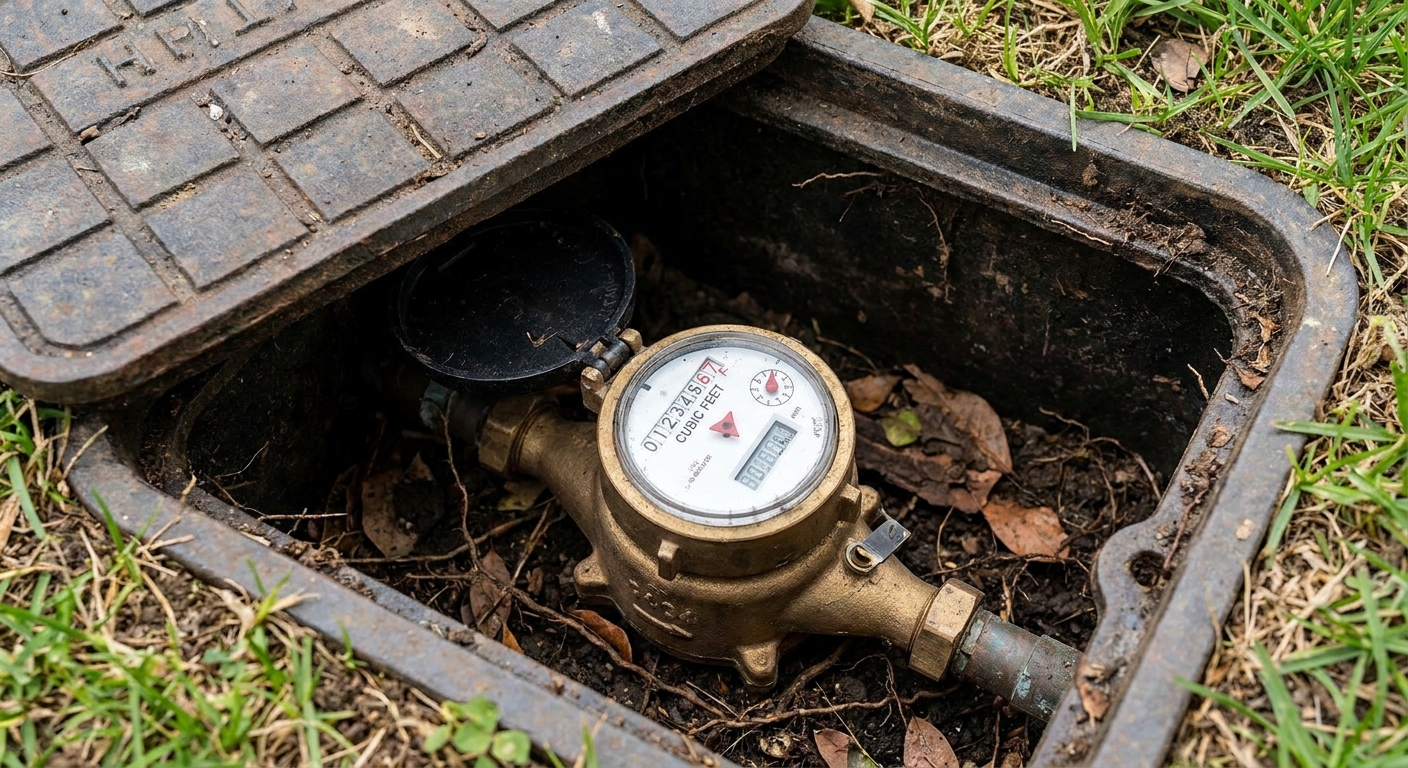
First, know what “movement” means on your meter
Most meters have one of these:
- Analog dial meter: Several small dials plus a very sensitive leak indicator. The leak indicator is often a tiny triangle or star-shaped wheel that spins with even a small flow.
- Digital meter: A screen that shows numbers, plus a flow icon or a rate like “GPM.” Many digital meters update the on-screen reading in intervals or batches, which can look like “movement” even when nothing’s running. The sensor isn’t “catching up” to old flow, the display is just posting updates.
What’s suspicious?
- Constant, steady movement of the leak indicator (triangle or star) for several minutes is a strong sign of real flow.
- One brief twitch, then nothing can indicate a tiny pressure or temperature change, a valve adjusting, or an appliance topping off. If it keeps moving, treat it as flow.
- Digital meters that “jump” every so often may simply be updating. You’ll confirm with a timed test below.
The water meter leak test (step by step)
This is the baseline test. Do it before you start turning valves so you don’t chase your tail.
1) Pause automatic water users
- Ice maker
- Whole-house humidifier
- Water softener regeneration cycle (pause it if you can)
- Reverse osmosis tank refill (if you have one)
- Sprinkler or drip irrigation timers
- Boiler or hydronic heating system auto-fill (common on hot-water heat systems)
- Pool or spa auto-fill
If you can’t shut these off easily, just make sure they aren’t actively running during the test.
2) Make sure the house is truly quiet
- Confirm no showers, laundry, dishwasher, hose, or handwashing.
- Don’t flush toilets during the test window.
3) Record an initial reading (and note the unit)
At the meter:
- Analog: Take a clear photo of the full register and the leak indicator.
- Digital: Take a photo of the current reading and any flow icon.
Quick tip: meters may read in gallons, liters, cubic feet, or CCF. Jot down the unit so your “X units in 30 minutes” note actually means something later.
4) Watch for 2 full minutes
Analog: Stare at the triangle or star wheel. Even a slow crawl matters. If it spins continuously, you’ve got flow.
Digital: Watch for a flow icon, a “+” indicator, or a rate like 0.1 GPM. Some units go to sleep. If your meter has a customer-facing button, you may be able to wake the display. If it’s sealed or remote-only, check your utility portal or app for interval reads instead.
5) Do the timed “no touch” check
Walk away and don’t use water for 15 to 30 minutes. Then check again.
- If the register increased: There’s real water usage, which means a leak or an appliance or fixture drawing water.
- If nothing changed: What you saw earlier was likely a display refresh, a one-off cycle, or a brief pressure-related event.
My rule of thumb: If the meter shows usage over a quiet 30-minute window, it’s worth investigating. If it shows usage over a quiet 2 to 4 hour window (like overnight), I treat it as urgent, even if it’s a slow leak.
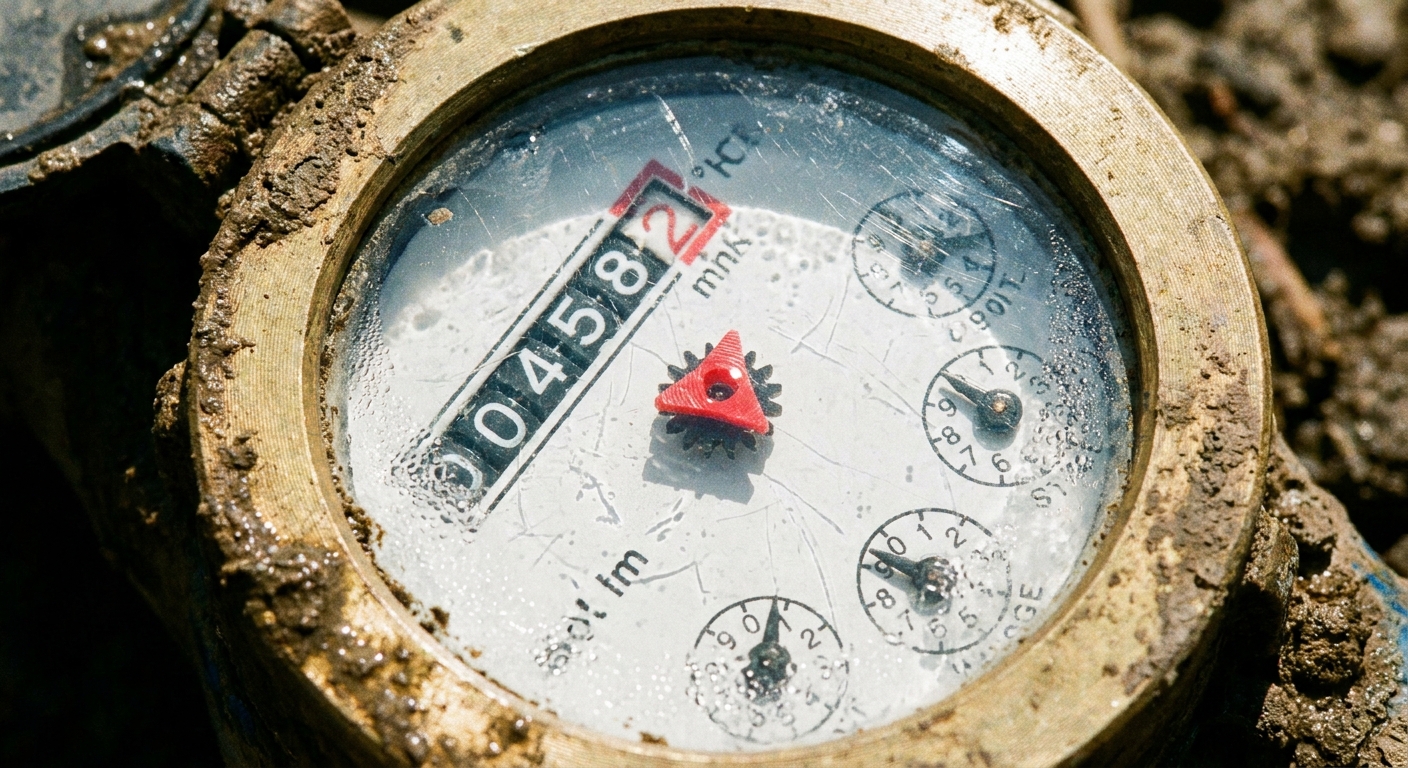
Small movement vs digital updates
Analog meters: tiny spins still matter
That little triangle or star is designed to catch the smallest flow. A toilet with a slow leak can spin it steadily even when you can’t hear a thing.
- Steady spin: Active flow right now.
- Stops and starts: Something is cycling or intermittently refilling (common with toilets, softeners, and auto-fill valves).
Digital meters: trust the timed photos
Digital meters can update the display in bursts, average flow over a short window, or show a slight delay after flow starts or stops. If you suspect a display delay, the timed photo method is the cleanest proof: two photos, 30 minutes apart, with no water used in between.
House or irrigation? Isolate it
Before you tear into walls or start digging, figure out which side of your system is guilty. One quick caution: some homes have irrigation tied in before the house shutoff, and some have it after. That wiring changes what “house off” proves.
Step A: Find your shutoffs
- Main house shutoff: Often in a basement, crawlspace, garage, or utility closet where the water line enters.
- Irrigation shutoff: Often near the main line, in a valve box, or right after a backflow preventer.
If you’re unsure, trace the piping or look for a labeled backflow device outside.
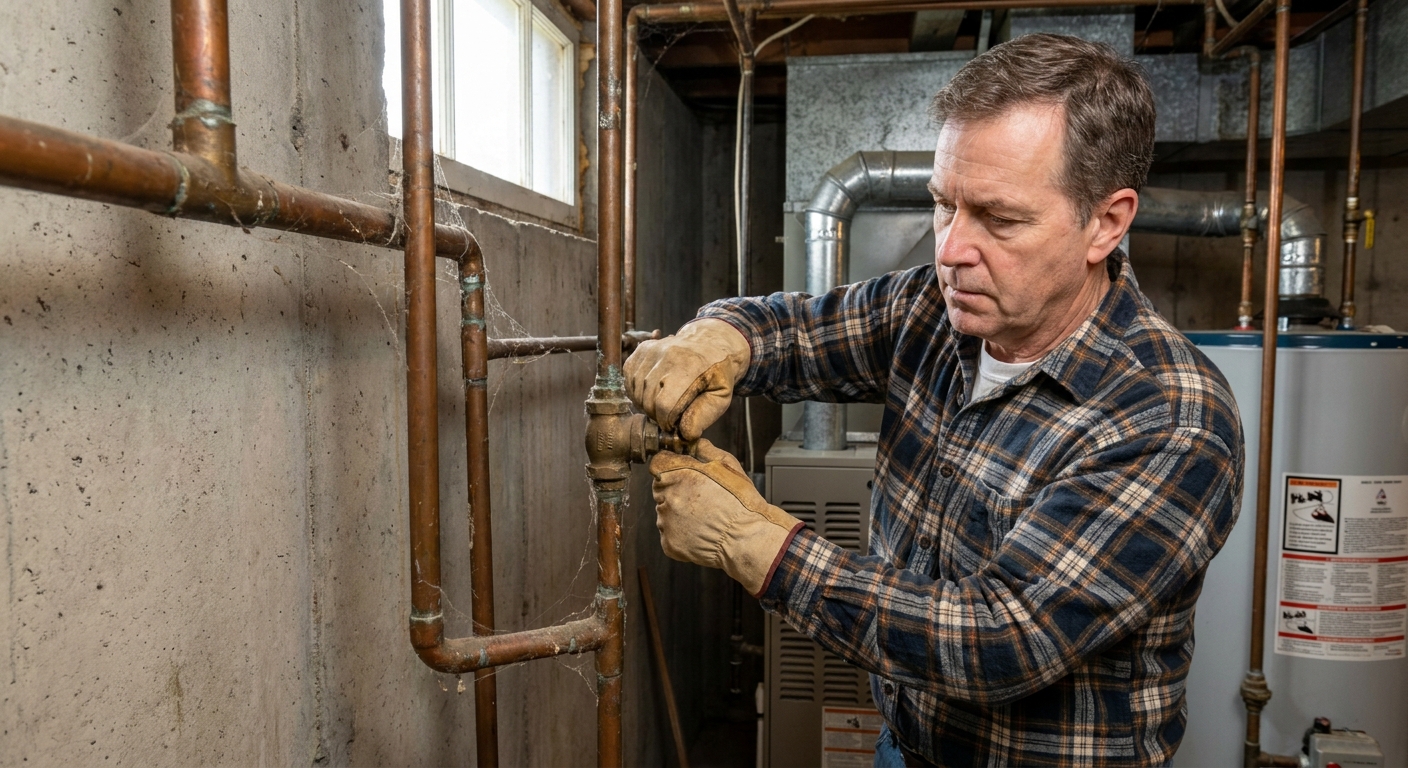
Step B: Test with the house main OFF
Turn off the main house shutoff valve (not the meter curb stop). Then check the meter:
- If the meter still moves: The leak is likely between the meter and your house shutoff, or on an irrigation branch that bypasses the house valve.
- If the meter stops: The leak is inside the house plumbing, or on something downstream of that house valve.
Step C: If you have irrigation, isolate it next
Now focus on irrigation. For this step, turn the irrigation shutoff OFF and re-test the meter. (You can leave the house main shutoff in whatever position makes sense for your setup, but keep track of it.)
- Meter stops when irrigation is off: Look for a stuck irrigation valve, broken drip line, or a cracked supply line to the sprinkler manifold.
- Meter still moves with irrigation off: You’re likely looking at a service line issue (meter to house), or another branch that bypasses both shutoffs. If your house main is currently OFF, this is not an indoor leak.
Common culprits (in the order I’d check)
1) Toilets: the #1 silent water waster
A toilet can leak for months with almost no sound. If your meter suggests a small, steady draw, start here.
- Quick test: Add a few drops of food coloring to the toilet tank. Don’t flush. Check the bowl after 10 to 15 minutes. If color appears in the bowl, the flapper or flush valve is leaking.
- Also check: Fill valve that periodically refills, chain that holds the flapper slightly open, overflow tube height.
Fixes are usually cheap: a flapper, a full tank rebuild kit, or adjusting the fill valve.
2) Outdoor spigots and hoses
Outdoor bibs love to drip where you can’t easily notice, especially behind shrubs or under a hose reel.
- Check for drips at the spout and behind the handle packing nut.
- Disconnect hoses and look for a slow seep. A hose nozzle left “on” can hide a leak at the bib.
- If you have freeze-proof sillcocks, a failed internal washer can leak into the wall and show up as meter movement.
3) Water softeners, filters, and recirculation
- Softener stuck in regeneration or leaking bypass valve.
- Whole-house filter housings with a slow drip.
- Hot water recirculation: a properly working recirc loop shouldn’t add make-up water by itself. If the meter moves, look for a crossover, a mis-plumbed valve, or a leak somewhere in the loop.
4) Hidden indoor leaks: under sinks, behind appliances
Check the usual suspects:
- Toilet supply stops and connectors
- Under-kitchen sink shutoffs and faucet supply lines
- Behind the washing machine
- Water heater area
- Fridge line for ice maker
One extra spot that’s easy to miss: the water heater T&P relief valve discharge line. If it’s weeping, you may see intermittent usage and water at or near the discharge pipe.
If you find moisture, handle it quickly. A small drip can become a rotten cabinet floor before you know it.
5) Slab leaks and wall leaks
If the meter moves with the house valve on, but you can’t find any fixture or visible leak, it may be in a wall or under a slab. Common clues:
- Warm spot on floor (hot water line leak)
- Unexplained damp flooring or baseboards
- Mildew smell that won’t quit
- Cracks in tile or flooring with no other explanation
If you want a deeper rundown of warning signs and what pros do next, see our related guide: Slab Leak Warning Signs.
If the meter moves with the house shutoff OFF
This result narrows things down fast, and it’s the one that makes me take a deep breath before I start.
If your main house valve is off and the meter still shows flow, the leak is usually in one of these places:
- Service line leak between the meter and the house shutoff.
- Irrigation feed that branches before the house shutoff.
- Hose bib tied in before the main house valve (less common, but I’ve seen it in older setups).
At this point, DIY options are limited because it often involves digging, specialty locating tools, or utility coordination. But you can still gather good info before calling for help.
What you can do next (without digging)
- Walk the yard and look for soggy spots, greener strips of grass, or areas that never dry.
- Listen near the foundation for a faint hiss, especially at night when it’s quiet.
- Check irrigation valve boxes for standing water or mud.
Also, a quick word of caution: if you think you need to shut off the curb stop at the meter, don’t force it. Old curb stops can snap. If it’s stuck, call your utility or a plumber.
When to call a plumber (and what to ask)
I’m all for sweat equity, but there are times when calling a pro is the thrifty move because it prevents bigger damage.
Call a plumber soon if:
- The meter shows continuous flow and you can’t locate it within an hour.
- You have any signs of slab or wall leakage (warm floor, damp baseboards, mold smell).
- Your meter moves even with the main house shutoff valve off.
- Your water bill jumped sharply and stays high month to month.
What to say on the phone
Give them your test results. It saves time and usually saves money.
- “The meter leak indicator spins continuously with all fixtures off.”
- “I shut off the main house valve and the meter still moved.”
- “With irrigation off, the meter still moved.”
- “The reading increased by X (gallons, cubic feet, CCF, etc.) over 30 minutes with no water use.”
What the plumber may do next
- Pressure test to confirm a hidden leak.
- Acoustic listening equipment or thermal tools to narrow the location.
- Isolation testing zone-by-zone to avoid unnecessary openings or digging.
If the suspicion is a slab leak, pros can often pinpoint before any concrete is touched. That’s the part worth paying for.
Two quick don’t-panic notes
1) A meter can move briefly without a true leak
Pressure changes in the neighborhood, a softener finishing a cycle, thermal expansion, or a digital display update can create small, temporary movement. That’s why the timed photo check is so helpful.
2) The fastest win is often a toilet
If you’re staring at a spinning leak indicator, I’d bet dinner that a toilet flapper is involved more often than not. It’s cheap, it’s common, and it’s easy to verify.
The 30-Second Cheat Sheet
Essential takeaways for: Water Meter Moves When Water Is Off? Find the Hidden Leak
Meter moving when everything is off? Do this first
- Stop all water use (no faucets, no laundry, no dishwasher). Pause irrigation timers and any auto-fill devices if possible.
- Take a photo of the meter reading (and the leak indicator or flow icon).
- Wait 15 to 30 minutes without using any water.
- Take a second photo. If the reading increased, you have real water flow.
How to interpret what you see
- Analog triangle or star spins steadily: active flow, almost always a leak or fixture draw.
- Digital display “jumps” sometimes: could be interval or batched display updates. Confirm by comparing two photos 30 minutes apart.
- Stops and starts: something is cycling, often a toilet refill, softener, or auto-fill.
Isolate house vs irrigation
- Turn OFF the main house shutoff valve (inside the home where the line enters).
- Check the meter again.
- Meter still moves: likely service line leak (meter to house) or irrigation branch before the house shutoff.
- Meter stops: leak is inside the house plumbing or on an indoor fixture.
Top culprits to check (fast)
- Toilets: food coloring in tank, wait 10 to 15 minutes. Color in bowl = leaking flapper/flush valve.
- Outdoor spigots: look for drips at the spout and behind the handle, disconnect hoses.
- Appliance lines: washing machine, water heater area, fridge ice maker line.
Call a plumber if
- Meter moves with the main house shutoff OFF.
- You suspect a slab or wall leak (warm floor, damp baseboards, mold smell).
- You can't find the source within about an hour and the meter shows continuous flow.
💡 Tip: Scroll up to read the full article for detailed, step-by-step instructions.
⬆️ Back to top
About Marcus Vance
Content Creator @ Grit & Home
Marcus Vance is a lifelong DIY enthusiast and self-taught home renovator who has spent the last decade transforming a dilapidated 1970s ranch into his family's dream home. He specializes in budget-friendly carpentry, room-by-room renovations, and demystifying power tools for beginners. Through his writing, Marcus shares practical tutorials and hard-learned lessons to help homeowners tackle their own projects with confidence.