
🚨 In a DIY emergency or rush?
Skip the details and jump straight to our 30-second cheat sheet for the most crucial info.
Small cooktop. Big home questions.
If your electric stove burner is stuck on high, glowing when the knob is off, or heating like it has a grudge, treat it like a live problem until proven otherwise. This one can move from “annoying” to “kitchen hazard” fast.
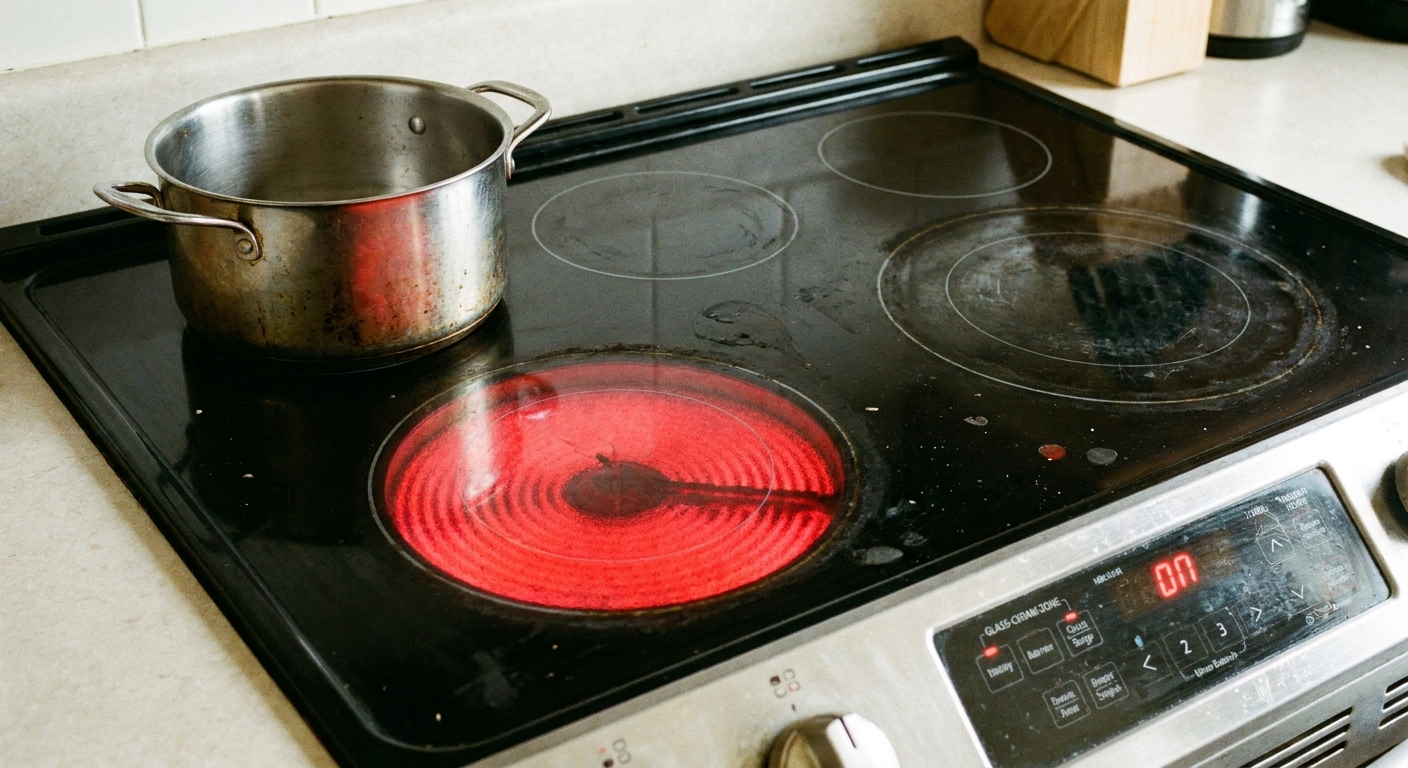
First: make it safe
If a surface burner will not turn off, the safest move is to cut power at the source, not at the knob.
- Turn the burner knob to OFF (yes, still do this).
- Do not move the pan with bare hands. If something is on the burner, use oven mitts and set it on a heat-safe surface.
- Shut off power at the breaker: find your electrical panel and switch the range breaker fully to OFF. Many electric ranges use a double-pole breaker labeled “Range” or “Oven.”
- If you cannot identify the correct breaker, turning off the main can be the safest move, but pause for household needs (medical devices, alarms, anyone working from home on critical gear). If in doubt, get help from someone qualified.
- Verify it is de-energized: do not use “it’s cooling down” as your proof. Look for signs the cooktop is dead (no active display, no burner-on lights). If you are qualified, verify with a proper tester. If you cannot verify, assume it is live and keep the breaker OFF.
One more thing: “hot surface” lights can stay on from residual heat even with power cut, especially on glass tops. That light is not a reliable power indicator.
If you see smoke, sparking, a burning smell that continues after power is cut, or flames, step back and call emergency services.
What “stuck on high” usually means
For most electric ranges, a surface burner heats because a control sends power to that burner. When the burner will not shut off, one of two things is typically happening:
- The control is stuck sending power (common). On many stoves this is an infinite switch behind the knob. On some models, especially those with touch controls, it can be a relay or other power-switching component on a control board that has welded closed.
- The burner or wiring is damaged (less common for “won’t turn off,” more common for “won’t heat” or “heats unevenly”). Shorts in wiring harnesses, miswired replacement switches, or contamination inside a switch can also create weird behavior.
Good news: you can often narrow down the likely culprit without fancy tools.
At a glance
- Knobs + one burner stuck on: infinite switch is the usual suspect.
- Touch panel + one burner stuck on: stuck relay or control board issue is likely.
- Burner comes on the moment you restore power: something is still feeding it power (switch, relay, wiring).
- More than one burner acting up: step back and consider service. That points to a bigger control or wiring problem.
Coil vs glass top
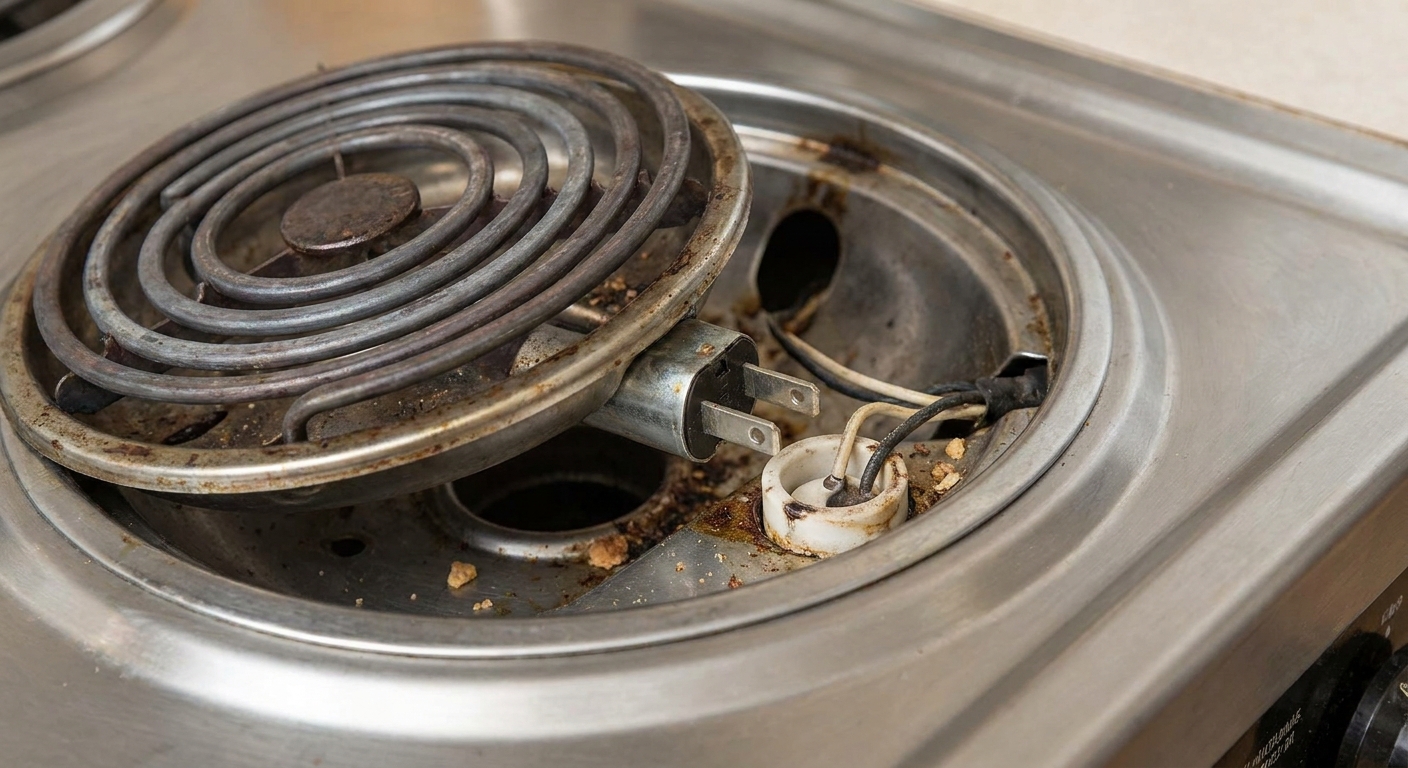
Coil burner
- The burner is a removable metal coil that plugs into a receptacle.
- Knobs are usually mechanical and click through settings.
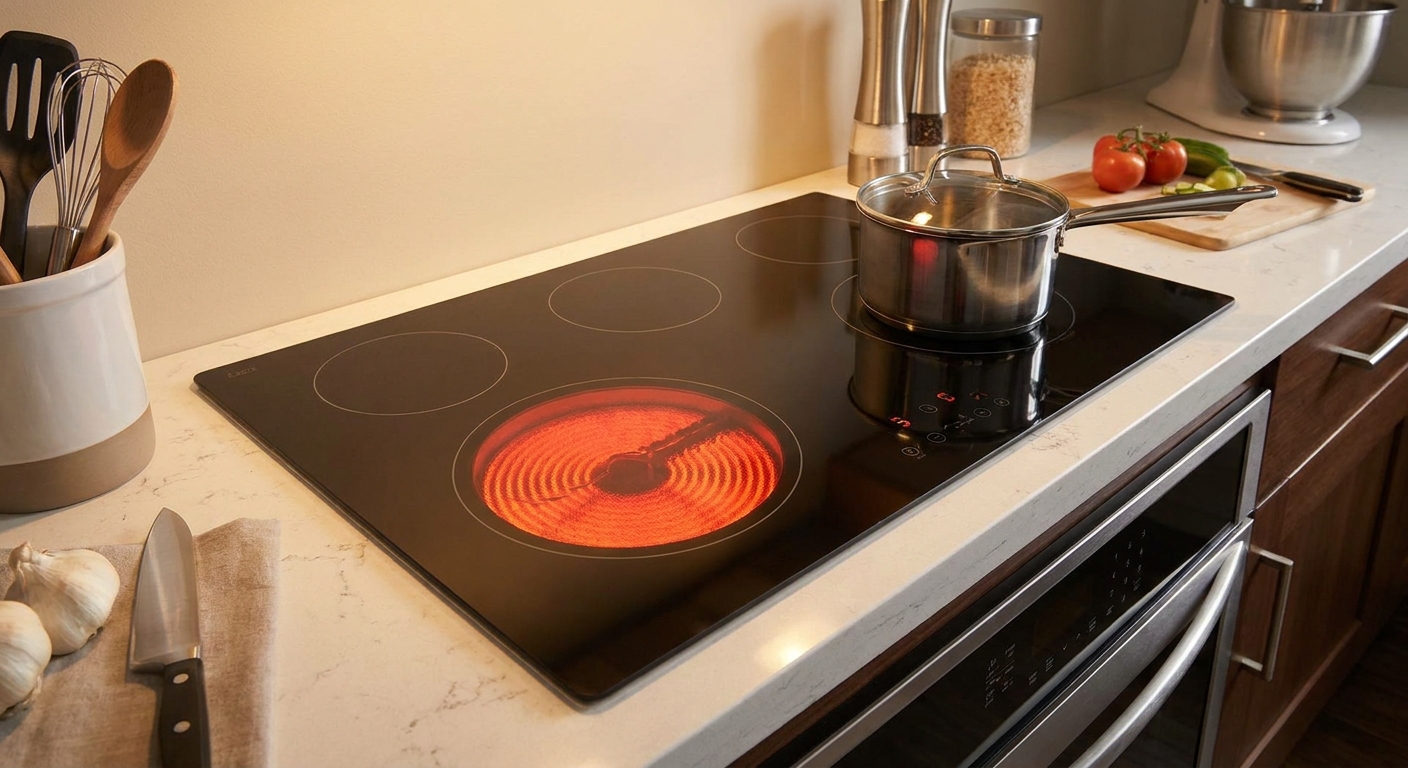
Radiant burner (glass top)
- The heating element sits under a glass surface and glows red through the glass.
- Controls can be knobs or a touch panel.
Quick note on induction
Not every glass top is radiant. If a magnet sticks strongly to the “burner” area and it only heats with induction-compatible cookware, you may have an induction cooktop. Induction “stuck on” behavior can involve different electronics and sensors, so consult your manual or schedule service.
Two questions that tell you a lot
1) Is it one burner or several?
- One burner stuck on points to a single infinite switch (knob model) or a single relay channel (some electronic models). Wiring to that burner can also be involved.
- Multiple burners acting wrong can point to a control board problem, wiring damage, or incorrect installation. That is a good moment to call for service.
2) Is it stuck on high only, or stuck on at any heat?
- Stuck on high is classic failed infinite switch behavior. The internal contacts can weld together and deliver near-continuous power.
- Stuck on low or cycles oddly can still be a switch, but also consider a loose knob, damaged shaft, wiring issues, or a control board problem on electronic models.
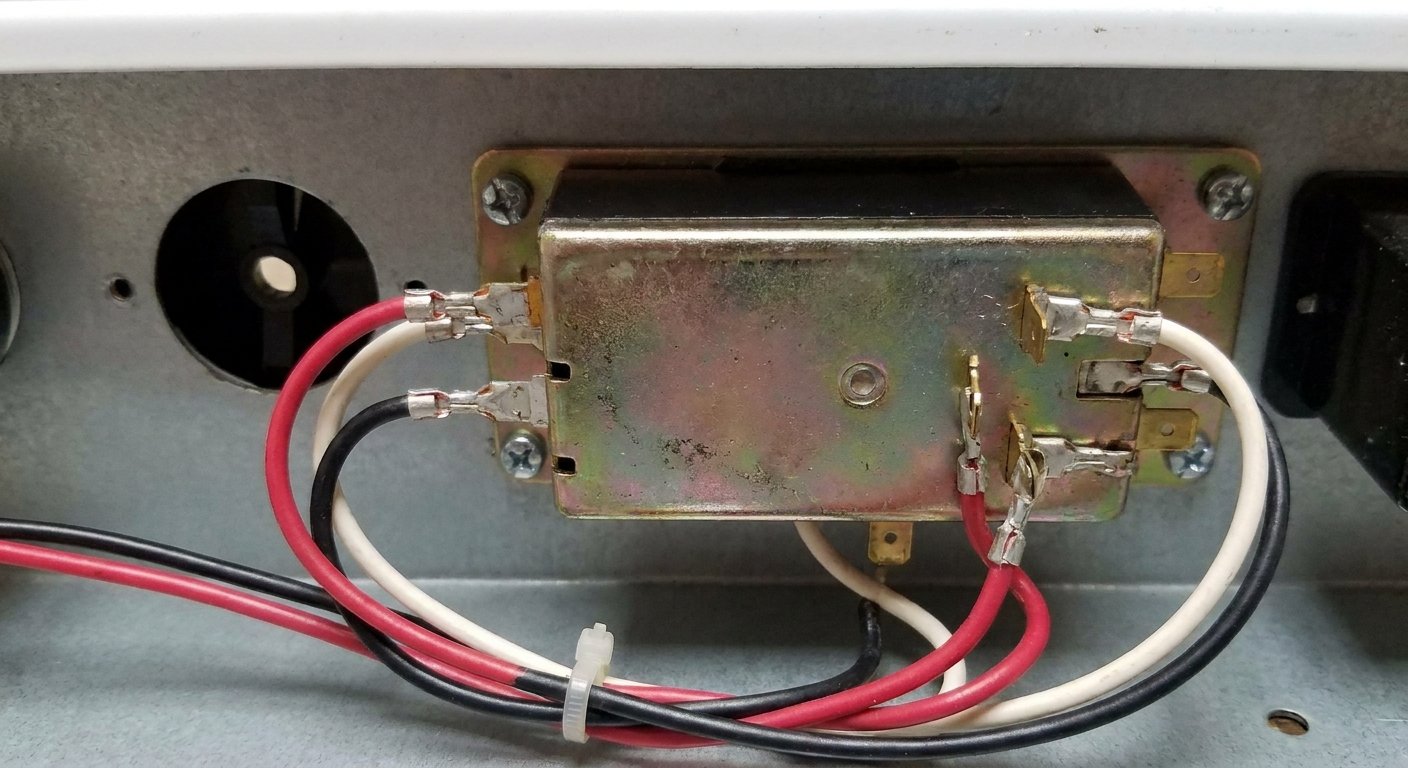
Knob controls: suspect the infinite switch
An infinite switch is the control behind each surface burner knob. It cycles power on and off to approximate heat levels. When it fails, it can get stuck in the ON position.
Signs the infinite switch is likely the problem
- The burner heats even with the knob set to OFF.
- The knob feels loose, wobbly, or does not “stop” crisply at OFF.
- You notice a burnt smell or discoloration near the knob area (with power off).
What you can do safely
- Keep the breaker OFF until the stove is repaired.
- Best practice: do not cook on this range until it is fixed. If you must cook, use an alternate appliance (microwave, toaster oven, slow cooker) rather than re-energizing a range that may power a stuck burner without warning.
- Find your model number (often inside the oven door frame or storage drawer frame). That helps you identify the correct switch part number.
Replacing an infinite switch is a common repair, but it involves opening the control panel and working near high-voltage wiring. If you are not comfortable identifying terminals and transferring wires one at a time, this is a solid “call a pro” moment.
Touch controls: suspect a stuck relay
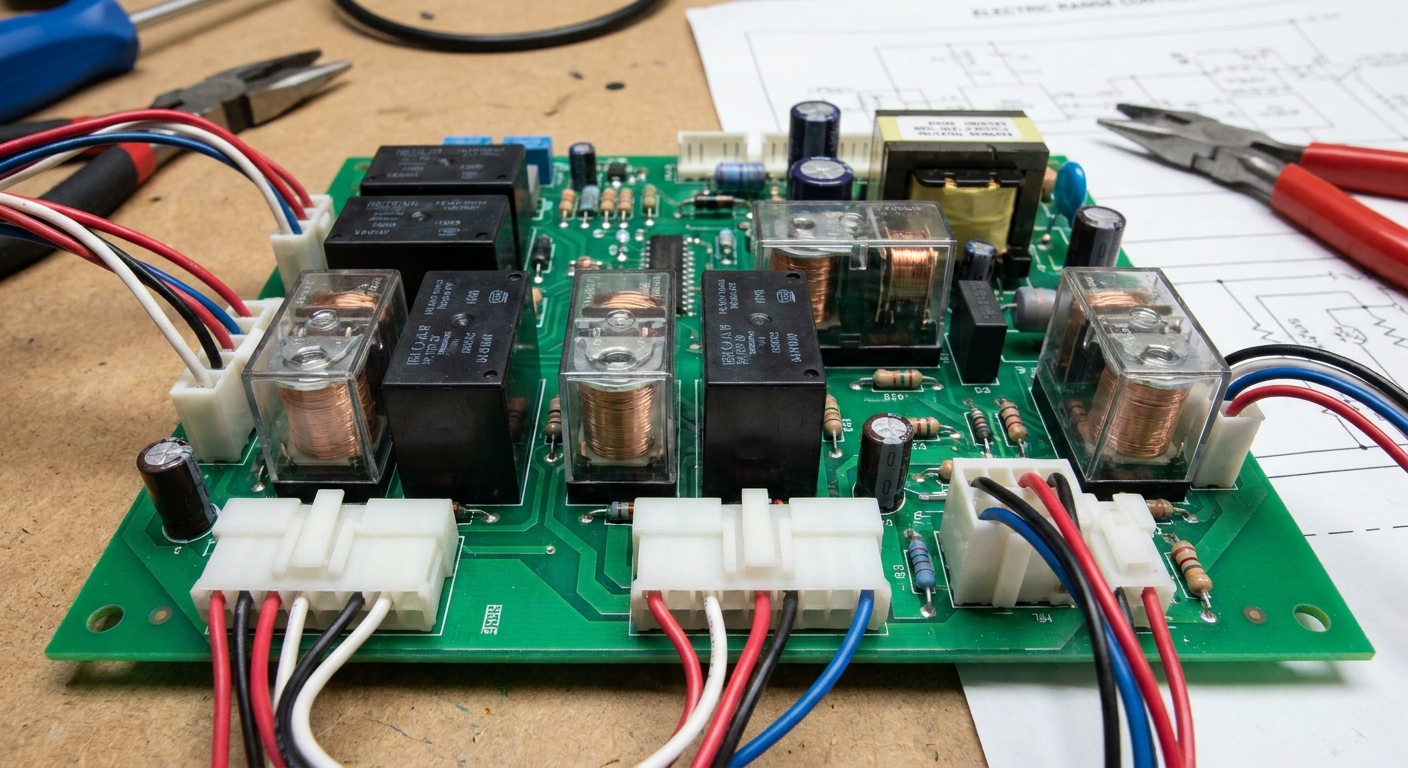
Some electric cooktops use a control board to operate burners, sending power through relays. When a relay fails, it can weld closed, leaving a burner powered even when the control says it is off.
Signs the control board may be at fault
- The burner heats even when the display indicates OFF.
- You see error codes, beeping, or glitchy control behavior.
- The burner turns on by itself when power is restored at the breaker.
Control boards are expensive and model-specific. Keep the breaker off and schedule service, or confirm the correct board using your model number before ordering anything.
Could it be the burner?
Usually, a surface burner that will not turn off is being fed power by a failed control. But the burner and its wiring can still be part of the story, especially if something shorted.
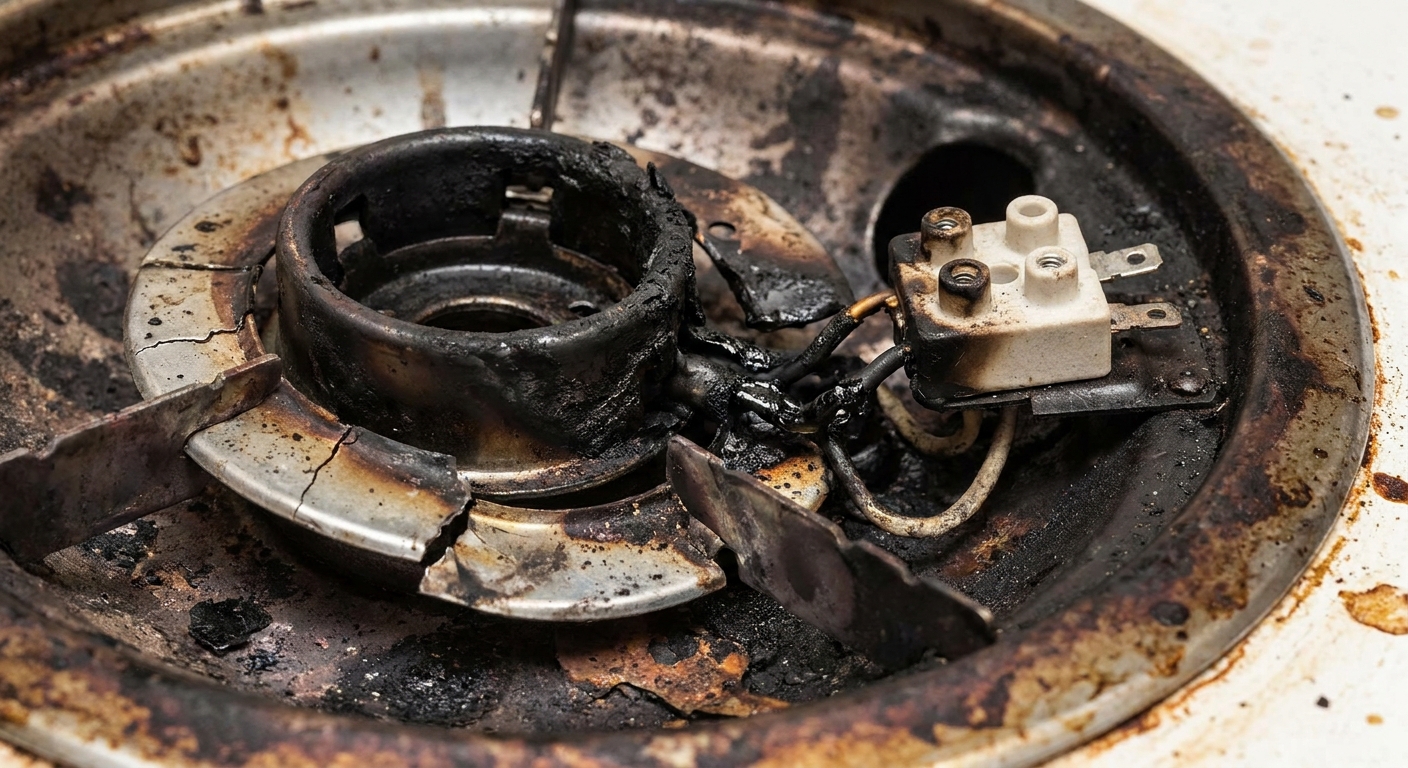
Coil burner: simple isolation check
Only do this with the breaker OFF. When everything is cool:
- Lift out the coil burner from the receptacle.
- Inspect the plug-in terminals for burn marks, melted plastic, or corrosion.
- Inspect the receptacle for heat damage.
If the receptacle is charred or the coil terminals are pitted, you may need a new receptacle kit and or burner. But remember: even a perfect-looking coil can still be controlled by a bad switch.
Radiant burner: what to look for
- Cracks or burn marks under the glass (visible through the top).
- Signs of overheating around the element mounts.
Radiant elements can fail, but a “won’t shut off” symptom still commonly points back to the control side.
What not to do
- Do not keep cycling the breaker hoping it “resets.” A welded switch or relay tends to come right back.
- Do not try to pull the knob off and force the shaft while power is on. If the control is failed internally, the knob position will not matter.
- Do not ignore a burning smell at the backguard or control panel. That can be overheating wiring or a failing switch.
- Do not use extension cords or improvised power to test anything.
After it is safe
- Write down the symptoms: which burner, what it does, whether it turns on immediately after power is restored.
- Take a quick photo of the model and serial tag.
- Do not order parts on a hunch. Use the model number to confirm compatibility, especially for control boards and infinite switches.
When to call for service now
- You cannot safely access your breaker panel or identify the correct breaker.
- The burner turns on as soon as power is restored, even briefly.
- You see melted wiring, a scorched receptacle, or any charring inside the control area.
- The range is under warranty, or the stove is a built-in cooktop with hardwired connections you cannot easily disconnect.
FAQ
Why is my electric burner stuck on high even when it’s off?
Most often, the control that feeds power to that burner has failed. On knob-controlled models, that is typically a bad infinite switch. On electronic models, it can be a relay or other power-switching component stuck closed on a control board. Rarer causes include shorted wiring or a miswired replacement part.
Can I keep using the stove if one burner won’t turn off?
Best practice is no. Restoring power may energize the stuck circuit again without warning. Keep the range breaker off until the issue is repaired, and use an alternate appliance if you need to cook.
Is this the same problem as the oven not turning off?
No. This guide is for a surface burner on the cooktop. Oven runaway issues involve different components and troubleshooting.
My burner is not stuck on, but it won’t heat at all. Is that related?
That is the opposite symptom. “Won’t heat” often points to a bad burner, bad receptacle, wiring issue, or control issue, but the diagnostic steps differ from a burner that will not shut off.
The 30-Second Cheat Sheet
Essential takeaways for: Electric Stove Burner Stuck on High or Won’t Turn Off?
Do this first
- Turn the knob to OFF, then shut off the range breaker (double-pole breaker labeled “Range” or “Oven”).
- Do not rely on the knob. If the burner is stuck on, keep power OFF until repaired.
What it usually is
- Knob controls: failed infinite switch behind the knob (classic cause of “stuck on high”).
- Touch or digital controls: a stuck relay (or other power-switching component) on a control board (often needs service).
- Rarer causes: shorted wiring, miswired replacement parts, or contamination inside a switch.
Fast clues
- Only one burner affected: points to that burner’s control path (switch, relay channel, or wiring).
- Turns on immediately when power is restored: strongly suggests the control is still sending power.
Safe checks (power OFF)
- Coil burner: pull the coil and inspect prongs and receptacle for burning or melting.
- Any model: if you smell burned plastic or see scorched wiring, stop and call for service.
Do not
- Do not keep flipping the breaker hoping it resets.
- Do not keep cooking on the range if restoring power makes the stuck burner come on again.
💡 Tip: Scroll up to read the full article for detailed, step-by-step instructions.
⬆️ Back to top
About Grit
Content Creator @ Grit & Home
Grit is Grit & Home’s little blue clay courier, delivering big questions about the place you call home. Expect practical ideas, a raised eyebrow, and a satchel full of curiosity.