
🚨 In a DIY emergency or rush?
Skip the details and jump straight to our 30-second cheat sheet for the most crucial info.
Small courier. Big home questions.
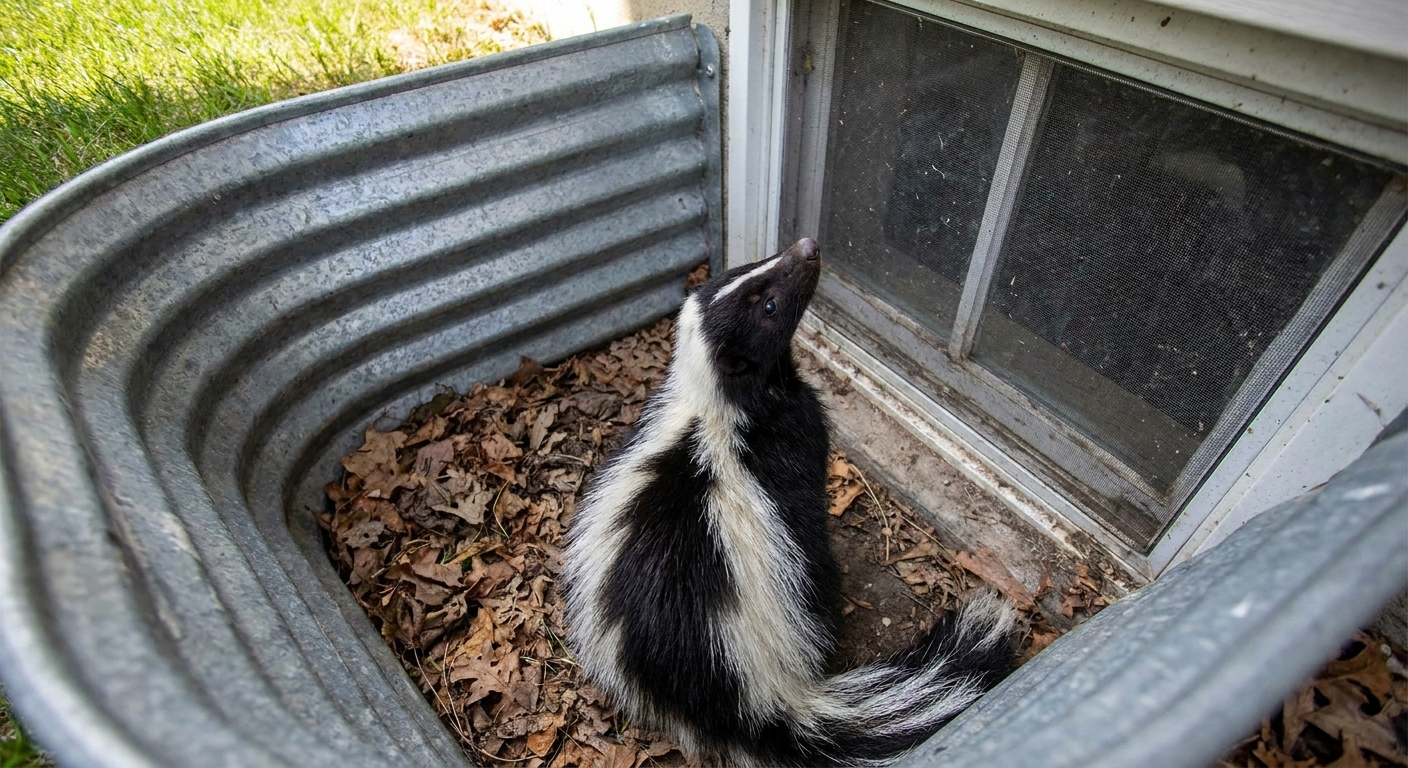
So you looked out and there it is. A skunk, stuck in your window well like it took a wrong turn on a midnight snack run. The goal is not to “handle” the skunk. The goal is to quietly give it a way out, then give your window well a future where this never happens again.
First, a quick safety check
A skunk in a window well is usually just stressed, not aggressive. But you should still treat this like a safety job.
- Keep kids and pets inside. Close the basement window and any nearby doors.
- Give it space. Do not lean over the well. Do not poke it with anything. Do not try to pick it up.
- Watch for injury. If the skunk is bleeding, limping badly, tangled in a grate, or seems unable to move normally, skip DIY and call wildlife control.
- Know the rabies rule of thumb. Rabies in skunks is uncommon but possible. If the animal is unusually bold, disoriented, staggering, or active in full daylight with no obvious reason, call a pro.
The calm exit plan (ramp, light, and timing)
Skunks are good climbers on rough surfaces. Most window wells are smooth metal or plastic, so they just cannot get traction. Your job is to add traction and a gentle “this way” cue.
Step 1: Set a rough ramp
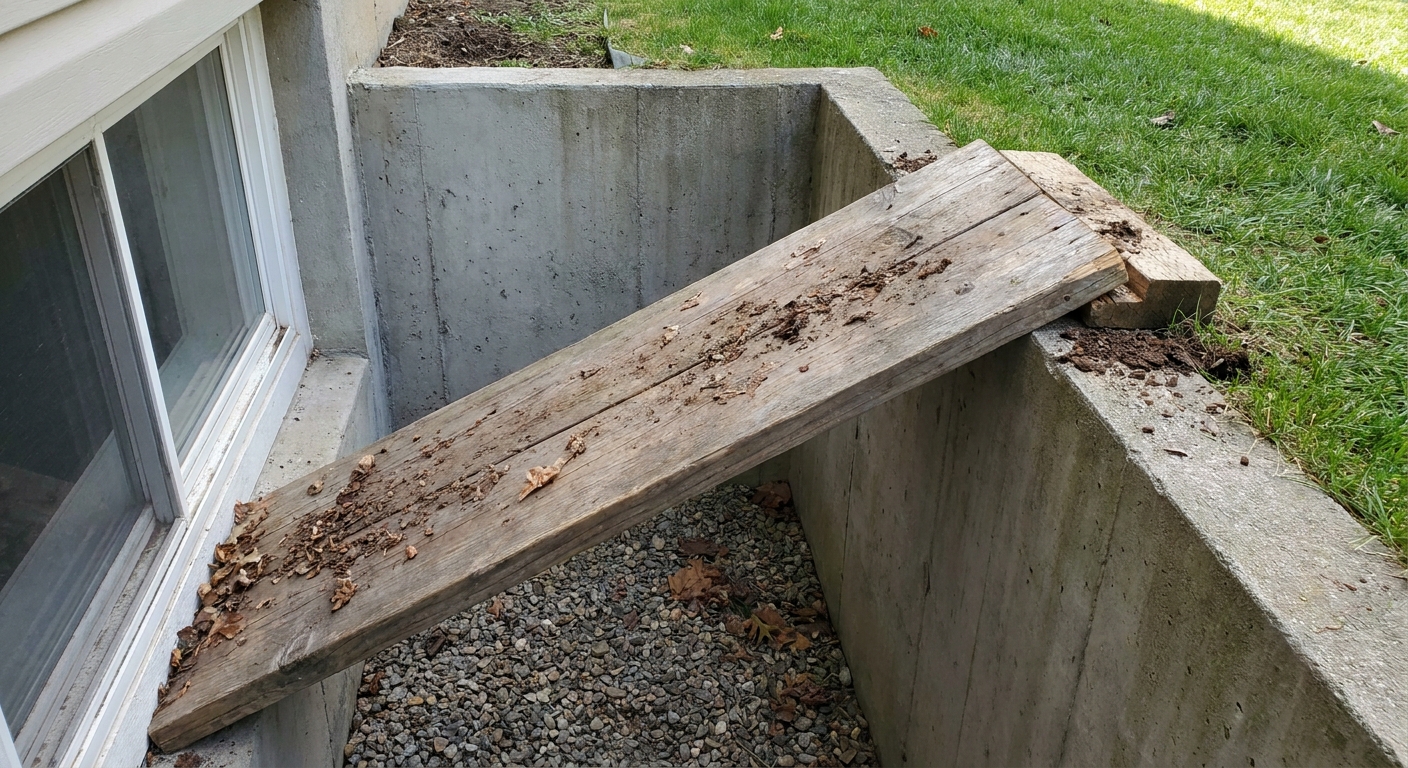
Use something long enough to reach from the bottom of the well to the ground above at a stable angle.
- Best options: a rough cut 2x10 or 2x12, a wide plank, a piece of plywood with a scrap strip screwed across as a cleat, or a ladder laid securely.
- Avoid: slick painted boards, thin sticks, or anything wobbly. If it flexes, it is a no.
- Make it easy to climb: If the board is smooth, tack on a strip of roofing shingle, staple on coarse sandpaper, or wrap it with a towel for grip.
Place the bottom of the ramp on the well floor and the top on the lawn so the skunk can walk straight up and out. The angle matters. Flatter is friendlier.
Step 2: Add a light cue (but do not spotlight the skunk)
Skunks prefer moving in dim conditions. Bright light can make them freeze, and freezing skunks make impatient humans do unwise things.
- At night: Put a work light or porch light on the far side of the yard to create a softly lit destination away from the well. Leave the well area itself relatively calm and dim.
- In early morning: Natural daylight is often enough. Avoid flashing a bright flashlight directly at the skunk’s face.
Think “gentle runway lighting,” not “interrogation lamp.”
Step 3: Use time of day to your advantage
The easiest window well rescues happen when skunks already want to move: dusk, night, or early morning.
- Evening plan: Set the ramp before dusk, then go inside and give it 1 to 3 hours.
- Morning plan: If you find it at sunrise, set the ramp and give it quiet time. Many will leave once the yard is calm again.
If you are standing over the well, talking, checking every 30 seconds, you are accidentally volunteering as the reason it stays put.
How to avoid getting sprayed
Skunks almost always spray because they feel cornered. Your whole strategy is built around “not cornering.”
Do these things
- Move slowly and keep your distance. Back away after setting the ramp.
- Keep a barrier between you and the skunk if you must be nearby. A piece of plywood held like a shield can reduce the chance of a direct hit if the skunk sprays. It is not a guarantee, just a smart layer.
- Stay downwind. If you can smell it already, adjust your position.
- Give it an empty escape route. Make sure the top of the ramp does not end at a fence corner, a barking dog, or a closed gate.
Avoid these things
- Do not try to trap it in a tote, trash can, or box. That is “cornered,” in skunk language.
- Do not spray it with water. It is not a raccoon raid. It is an anxiety problem.
- Do not use loud noise. No clapping, banging, or “shooing.” Stress goes up, spray odds go up.
- Do not attempt relocation. In many areas it is illegal without a permit, and it is risky for you and the skunk.
If the skunk will not leave
Most will use the ramp once the yard is quiet. If yours is still there after a reasonable window, try these adjustments.
Make the ramp easier
- Widen it if you used something narrow.
- Lower the angle by shifting the top farther out onto the lawn.
- Add traction, even if you think it is rough enough.
Reduce the “threat” feeling
- Close blinds and keep pets away from windows. Staring is pressure.
- Stop checking it constantly. Give it an hour of true quiet.
- Turn off motion lights aimed at the well.
Consider a one-way cover, carefully
If rain or predators are a concern and the skunk is calm, you can loosely drape a towel or light blanket over part of the window well edge to create a darker “tunnel” toward the ramp. Do not block airflow. Do not trap it in. Do not let the fabric touch the skunk.
When to call wildlife control
Sometimes the right move is to hand this to someone with the right equipment and training.
- Injury or entanglement: bleeding, broken limb suspicion, stuck in a grate, wedged behind something
- A baby skunk: very small, crying, or multiple babies in the well
- High-risk location: the only access requires you to lean over the animal, or the well is deep and cramped
- Odd behavior: disorientation, staggering, seizures, extreme aggression, or unexplained daytime lethargy
- It has been there all day: especially in hot weather, where dehydration becomes a concern
If you need urgent guidance and you are in the U.S., your state wildlife agency website is a good place to find licensed operators. Many counties also have animal services numbers that can point you the right way.
After it leaves: prevent the next fall
A window well is basically a tiny, accidental animal trap. The long-term fix is a cover.
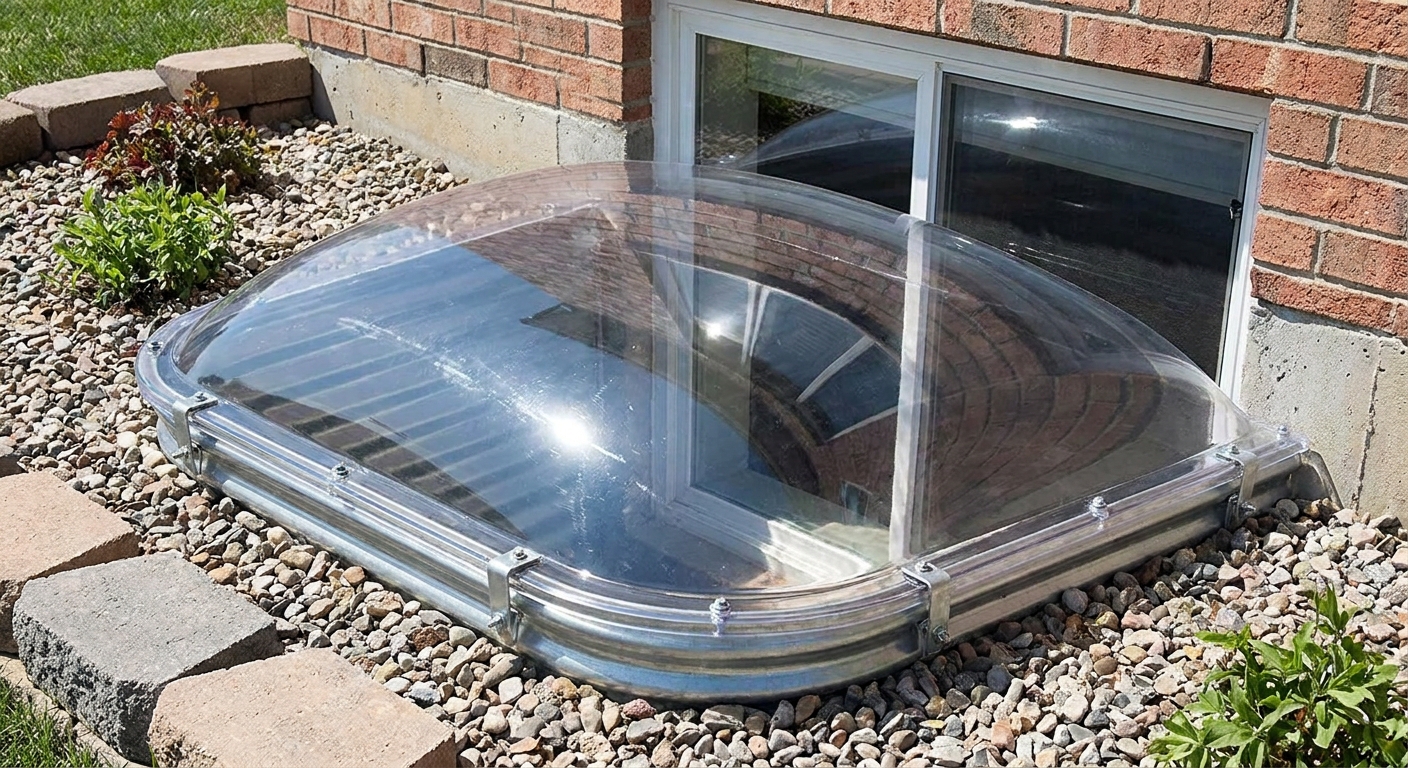
Install a window well cover
Look for a clear polycarbonate cover or a metal grate style that fits your specific well shape. A good cover helps with:
- Animals falling in
- Leaves and debris piling up
- Curious pets investigating the hole
Make sure the cover is secured so wind does not flip it, but also make sure it does not block egress if the window is required as an emergency escape in your home.
Check the well lip and surrounding grade
Skunks and other wildlife tend to slip in where the edge is uneven or where soil slopes toward the opening. Firm up loose soil around the rim and keep mulch from building a ramp into the well.
FAQ
Should I put food in the window well to lure it out?
No. Food keeps the skunk hanging around and can attract other animals. The ramp is the lure.
Will a skunk climb a ladder?
Often, yes, if it is stable and the rungs are close enough to feel like steps. A wide board with traction is usually easier than a narrow ladder.
How long should I wait?
If the ramp is solid and the area is quiet, many skunks leave within an hour or two after dusk, or within a similar window once things calm down in the morning. If it is still there after several hours and especially if temperatures are extreme, call wildlife control.
What if it sprays in the window well?
Close windows, give it time, and ventilate the area later. Do not try to “solve” the smell by confronting the skunk. If spray got into basement window frames or screens, a mild soap and water wash after the skunk is gone helps, followed by ventilation.
The 30-Second Cheat Sheet
Essential takeaways for: Skunk in a Window Well? How to Get It Out Safely
Goal
Help the skunk climb out safely without getting sprayed. Do not handle it. Give it traction and time.
What to do (fast)
- Put pets and kids inside. Close the basement window.
- Set a ramp: wide rough board (2x10 or 2x12) from the bottom of the well to the lawn. Add traction with a towel, shingles, or coarse sandpaper if needed.
- Use timing: best at dusk, night, or early morning. Then go inside and give it 1 to 3 hours of quiet.
- Lighting: avoid shining bright light in the skunk’s face. Keep the well area calm and dim. If needed, light the yard away from the well as a gentle “exit direction.”
How to avoid getting sprayed
- Move slowly, keep distance, stay downwind.
- Do not corner it. No yelling, no poking, no water spray.
- If you must be nearby, hold plywood as a shield, then back away.
Call wildlife control if
- The skunk is injured, tangled, or stuck.
- It is a baby skunk or there are multiple babies.
- It acts disoriented or unusually aggressive.
- It has been there all day, especially in heat or cold.
Prevent the next fall
- Install a secured window well cover that does not block required emergency egress.
- Keep the rim clear of loose soil and mulch that slopes into the well.
💡 Tip: Scroll up to read the full article for detailed, step-by-step instructions.
⬆️ Back to top
About Grit
Content Creator @ Grit & Home
Grit is Grit & Home’s little blue clay courier, delivering big questions about the place you call home. Expect practical ideas, a raised eyebrow, and a satchel full of curiosity.